My father-in-law threw me and my six children into freezing rain. Then I said the name on the property deed
“Only real blood belongs under this roof,” my father-in-law said.
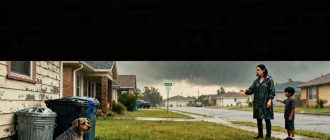
Patrick Callahan’s words were colder than the rain pouring over the driveway of the gated house in Pine Valley. It was nearly midnight, and the storm was relentless. Water ran down my face and soaked through my coat as I held my eleven-month-old daughter against my chest.
Sophie was burning with fever.
Behind me stood my five other children. Benjamin, thirteen, held two garbage bags filled with whatever clothes my mother-in-law had thrown at us. Grace and Abigail cried into each other’s arms. The twins, Samuel and David, pressed themselves against my legs, shivering in their school jackets.
My husband, Andrew, had been buried eight days earlier.
Only eight days.
His slippers were still beside the bed. His medication still sat on the bathroom counter. I still woke in the middle of the night thinking I needed to check his breathing. Illness had taken him slowly, month by month, while his parents appeared only when doctors, bills, inheritance, or public appearances were involved.
“Patrick, please,” I said, forcing my voice not to break. “These are your grandchildren. This was Andrew’s home too.”
Patrick stood in the doorway, warm and dry, wearing a robe that probably cost more than my first car. Behind him, Margaret Callahan stepped forward, flawless as ever, a designer shawl draped over her shoulders.
“It was Andrew’s home because we allowed it,” she said. “But you were never one of us, Cynthia. A woman from nothing doesn’t become a Callahan just because she marries one.”
Benjamin stepped in front of me.
“My dad said Mom and us would stay here. I heard him.”
Patrick’s eyes narrowed.
“Children should stay out of adult matters.”
“You’re lying,” Benjamin said.
Patrick slapped him.
The sound cracked through the storm.
Grace screamed. The twins started crying. Something inside me went still — not weak, not frightened, but dangerously calm.
“Never touch my son again,” I said.
Patrick laughed.
“And what exactly will you do? Sue me? With what money? The same poverty my son dragged you out of?”
Margaret dropped another bag onto the ground. It split open, spilling pajamas and socks into the mud.
“We changed the locks,” she said. “If you come back, we’ll tell everyone you’re unstable. A grieving widow with six children doesn’t need much help looking desperate.”
Through the rain, I saw faces in the windows. Relatives. Neighbors. Cousins who had hugged me at Andrew’s funeral and said, “Call if you need anything.” They watched from behind glass.
No one came out.
For fourteen years, I had stayed silent for Andrew. Silent when his parents called me an outsider. Silent when Margaret mocked my family. Silent when Patrick said Andrew had “married beneath him.” Silent even when Andrew was dying and they cared more about the house than the man fading inside it.
But that night, silence ended.
Inside the diaper bag was a yellow folder. Andrew had placed it in my hands three weeks before he died. He had been weak, but his eyes were clear.
“Cynthia,” he whispered, “if my parents ever try to force you out, find attorney Rebecca Stone. Don’t open this until that day comes. Promise me.”
I promised.
Now I understood.
I took Benjamin’s hand and started walking down the soaked driveway. After a few steps, I stopped and turned back.
“Before you celebrate,” I said quietly, “you might want to check who actually owns this house.”
Patrick’s smile disappeared.
“What did you say?”
“The deed, Patrick. Not your pride. The deed.”
Margaret’s face lost its color.
“That’s impossible.”
I didn’t argue in the rain. I walked with my children to the security office. The guard, who had been frozen in shame, finally opened the door. He gave the children blankets, called a doctor for Sophie, and let me use the phone when mine died from the storm.
Rebecca Stone arrived less than an hour later, wearing a black raincoat, carrying a leather briefcase, with two police officers beside her.
Patrick and Margaret were still on the porch.
They looked smaller now.
Rebecca opened the folder on the guard’s desk.
“Mr. and Mrs. Callahan,” she said, “this property was legally transferred by Andrew Callahan to his wife, Cynthia Callahan, four months before his death. The deed was recorded. In addition, a residential protection clause was established for their six minor children.”
Patrick slammed his hand on the railing.
“Andrew was sick. He didn’t know what he was signing.”
Rebecca did not flinch.
“A physician certified his capacity the same day. Your son was fully aware. Apparently, he was also fully aware of whom he needed to protect his family from.”
Margaret whispered, “Andrew would never do this to us.”
I looked at her.
“He didn’t do it to you. He did it for his children.”
One of the officers asked Patrick for the keys. He refused.
Rebecca glanced at the security camera above the gate.
“We also have footage of you striking a minor and forcing six children into severe weather. I suggest you consider carefully whether you want this conversation to continue here or at the station.”
The keys landed on the desk.
That night, we went back inside.
The house felt different. The portraits, the marble floors, the staircase Margaret had always treated like a throne room — none of it frightened me anymore. I dried the children, gave Sophie medicine, wrapped the twins in blankets, and made hot chocolate with shaking hands.
Benjamin sat at the kitchen table, a red mark on his cheek.
“Did Dad know they would do this?” he asked.
I sat beside him.
“Dad knew we needed to be safe.”
“Grandpa said we’re not real blood.”
I took his face gently in my hands.
“Your father is in every one of you. In your courage. In Grace’s laugh. In the twins’ stubbornness. In Sophie’s eyes. No one can erase that with cruel words.”
The next few days were ugly. Patrick and Margaret tried to rewrite the story. They told relatives I had manipulated Andrew while he was dying. They said I stole the house. They said I was unstable.
But the deed was real.
The security footage was real.
And the relatives who had watched from the windows began sending messages. “We didn’t know what to do.” “We were shocked.” “We’re sorry.”
I did not answer most of them.
They knew how to watch.
That was not enough.
A judge issued a protective order keeping Patrick away from Benjamin. Margaret never once asked if Sophie’s fever had broken. That hurt, but it also freed me. I stopped waiting for love from people who only knew how to protect a name.
When spring came, the children and I planted six small apple trees in the garden. One for each of them. Benjamin brought a seventh sapling from the nursery and placed it near the back porch.
“This one is for Dad,” he said.
We planted it together.
The house still hurts sometimes. Andrew is in every room. His books, his chair, the quiet space at the dinner table. But it no longer feels like a place where I was tolerated. It is our home now — not because of marble floors or iron gates, but because the man I loved made sure his children would never be thrown away by people who mistook cruelty for bloodline.
That night, Patrick said only real blood belonged under that roof.
He was right about one thing.
Real blood stayed.
But it wasn’t his pride, his name, or his cold idea of family.
It was six children loved by their father — and a mother who finally stopped begging for shelter in a house her husband had already left in her hands.