My mother disowned me for marrying a single mother. Three years later, she walked into my home and burst into tears
My mother never simply said, “I love you.”
She said, “I sacrificed everything for you.”
As a child, I thought those were the same thing. Later, I realized they were not. Love should not feel like a bill placed on the table every time you make a choice.
My father left when I was six. I remember his suitcase by the door, rain on his coat, and my mother standing in the hallway with a face so still it frightened me more than crying would have.
After that, she raised me alone.
But not softly.
My mother, Vivian, came from money. Old money. Polished manners, private clubs, expensive schools, the kind of family where disappointment was never shouted, only served cold across dinner.
I became her life’s project.
Private school. Violin lessons. Debate club. Summer programs. The right clothes. The right accent. The right future.
“Ethan,” she used to say, “you do not have the luxury of becoming ordinary.”
She never asked what I wanted.
She had already decided.
When I was twenty-eight, I met Anna.
She worked night shifts at a medical center, drove an old dented Honda, and was raising her seven-year-old son, Noah, alone. She did not look like the woman my mother imagined for me. She did not have a family name that opened doors. She did not have a life arranged into elegant pieces.
She had tired eyes, steady hands, and a heart that made people feel safe.
Noah did not trust me at first. He was polite, careful, and far too serious for seven.
“If you say you’re coming,” he asked me once, “do you actually come?”
“Yes,” I said.
He studied me.
“My real dad says that too.”
So I learned that love, for Noah, would not be a speech.
It would be showing up.
When I introduced Anna to my mother, I hoped for restraint.
I got cruelty.
My mother looked at Anna, then at Noah sitting quietly beside her, and said:
“She comes with baggage.”
Anna went pale.
Noah stared at his shoes.
“Mother,” I warned.
But she continued.
“You have education, position, prospects. And you are throwing your future away on a woman with another man’s child.”
That was the moment something in me changed.
Not because she insulted me.
Because she made a little boy feel like a burden.
When I told her Anna and I were getting married, my mother stood, smoothed the front of her jacket, and spoke with perfect calm.
“If you marry her, never come to me for anything. Not money. Not advice. Not comfort when you realize you ruined your life.”
I married Anna.
It was a small wedding at city hall. Two friends came. Noah carried the rings in a little wooden box he had painted blue. My mother did not attend.
For three years, she did not call.
Anna and I rented a small house on the edge of town. It was not impressive. The porch creaked, the kitchen cabinets were old, and the backyard was mostly weeds the first summer. But bills were paid. The fridge was full. The house was peaceful.
Peace was new to me.
Anna came home from night shifts and fell asleep with her head on my shoulder. Noah did homework at the kitchen table. I learned how to pack school lunches, fix bike chains, attend parent-teacher meetings, and understand that fatherhood is not only biology.
It is presence.
A few months after the wedding, Noah walked into the kitchen holding a math worksheet.
“Dad, can you help me?”
The room stopped.
Anna froze at the sink.
Noah’s face turned red.
“I mean Ethan,” he said quickly. “Sorry.”
I knelt in front of him.
“No,” I said. “Dad is fine. More than fine.”
He hugged me so hard I had to close my eyes.
From then on, I was Dad.
Last week, my phone rang.
Mother.
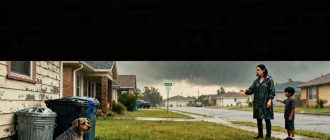
“I hear you have a… family now,” she said, pausing as if the word tasted strange. “I’m in town. I’ll come tomorrow. I want to see how badly you destroyed your life.”
After the call, Anna touched my arm.
“You don’t have to let her in.”
“I know.”
But I did.
Not because she deserved it.
Because I no longer needed to hide my happiness from her judgment.
She arrived the next afternoon in a cream coat, flawless hair, and the sharp eyes of a woman prepared to be disappointed.
She stepped inside.
And stopped.
The hallway held three pairs of shoes: Anna’s sneakers, my work boots, Noah’s muddy school shoes. On the fridge were drawings, spelling tests, and a crooked photo strip from a fair. The living room smelled like banana bread. On the wall hung pictures of the three of us hiking, laughing, messy and real.
At the old upright piano we had bought secondhand, Noah sat playing a simple song.
Not perfectly.
Happily.
My mother gripped the doorframe.
“Oh God,” she whispered. “What is this?”
Noah stopped playing.
“Hi,” he said. “Are you my dad’s mom?”
My mother looked at me.
“He calls you Dad?”
“Yes.”
“And you allow that?”
“I earned it.”
She sat down slowly, as if her legs had forgotten their purpose.
Anna brought tea. Calmly. Kindly. Not weakly. That was Anna’s gift: she could be gentle without surrendering her dignity.
Noah told my mother about school, about piano, about the science fair, about how I taught him to ride his bike without training wheels. She listened, and I watched her version of my ruined life begin to collapse.
When Noah ran outside, Anna followed him, leaving my mother and me at the kitchen table.
“I thought I would find chaos,” my mother said. “A tired woman using you. A child taking what was yours. A small life.”
“You found my home.”
Her eyes filled.
“Yes.”
I had never seen my mother cry.
“I raised you like an investment,” she whispered. “Because when your father left, I felt worthless. I thought if you became impressive enough, no one would see what he did to me. And when you chose a life I could not control, I felt abandoned again.”
“You abandoned me first,” I said quietly.
She closed her eyes.
“I know.”
It did not fix everything.
One honest sentence does not erase years of control, silence, and shame.
“If you want to be in our lives,” I said, “you begin with respect. Anna is my wife. Noah is my son. He is not baggage. He is not a mistake. And my life is not ruined.”
She nodded.
Then she asked to speak to Anna.
“I was cruel,” she said when Anna came back inside. “To you and to your son. I called him baggage because I did not understand I was the one carrying the heaviest load.”
Anna did not soften immediately.
“Noah never hears that word again.”
“He won’t.”
“And Ethan is not something you own.”
My mother looked at me, then back at Anna.
“I know that now.”
That day did not magically make us a perfect family. Life is not that simple. My mother did not become warm overnight. But she began.
She visits sometimes on Sundays. She brings fruit, not instructions. She sits by the piano and listens to Noah play. Once, she started to correct his hand position, caught herself, and said, “Sorry. Old habits.”
A few weeks later, Noah asked:
“Can I call you Grandma Vivian?”
For the first time in my life, my mother looked at me for permission instead of taking control.
I nodded.
She cried again.
My mother came to see the ruins of my life.
She found a small house, a brave woman, a boy who called me Dad, and a kind of love she had spent her whole life mistaking for weakness.
And maybe she finally understood:
I did not destroy my future by choosing Anna and Noah.
I destroyed the cage she built around it.