Doris stood in the church basement, thumbing through a stack of paper napkins, when her daughter Laura ran in and practically screamed.
“Mom, you have to see this. Amanda’s in the bathroom having a meltdown. Over the *ring*.”
“What about it?” Doris didn’t look up. She’d already heard Amanda complain twice that morning about the rustic venue, the folding chairs, the fact that Mike’s pickup was the “getaway vehicle.” A ring meltdown was just more noise.
“She says it’s too small. That Mike cheaped out. She used the word ‘pathetic.’” Laura shook her phone. “I’m serious, Mom. She’s in there texting her friends that she’s marrying a dude who can’t afford a proper rock.”
Doris set the napkins down. “Mike paid eight hundred dollars for that band. It was his grandmother Adelaide’s — melted down and reshaped because Amanda wanted something ‘modern.’”
“Well, apparently modern means ‘at least a carat.’”
Doris’s jaw tightened. She’d never liked Amanda. The girl had big-city-girl eyes that flickered past everything in Maplewood like it was a truck stop. She’d met Mike at a construction expo in Columbus two years ago, and since then she’d treated Ohio like a prison sentence. Mike, God love him, was blind to it. He’d been building them a house on the old Keller lot, pouring every dollar into concrete and wiring, and Amanda still talked about “getting back to Chicago” one day.
Upstairs, the organist started warming up. Doris smoothed her dress and went to find Mike. He was in the tiny vestibule with his best man, Tommy, who was down on one knee trying to fish something out of the floor grate.
“What’s going on?” Doris asked.
Mike’s face was pale. “The ring. I was holding Amanda’s, and Tommy bumped my elbow, and it just… it rolled right into the vent.”
Doris crouched. The grate was old iron, fixed to the floor with rusted screws. Below it, a dark gap and the faint glint of gold. “Can we reach it?”
Tommy sat back on his heels. “No way. It’s down in some kind of pocket. I’d need a magnet and a good hour.”
Amanda appeared in the doorway, veil still attached but crooked, mascara already smeared. “Please tell me you did not just drop my wedding ring into a hole in the ground.”
“I can get it,” Mike said quickly. “I’ll pry the grate off after the ceremony.”
“After the ceremony? I’m supposed to stand up there with a naked finger while your hillbilly relatives stare at me?” She grabbed his arm. “This is an omen, Mike. My mom always said a ring that hits the floor before the vows means the marriage ends in tears.”
Doris wanted to snap *it didn’t hit the floor, it vanished into the plumbing*, but she bit her tongue. The church was filling up. Mike kissed Amanda’s forehead and promised everything would be fine. Amanda pulled away, smoothed down her dress, and walked toward the altar like she was heading into a hostage negotiation.
The ceremony was short and dry. Amanda slipped on Mike’s ring without incident, but when it was his turn, he had to use a cheap silver stand-in from the bridal emergency kit. Amanda’s smile was tighter than a drum. At the reception, the best man’s toast was interrupted by the catering staff dropping a tray of deviled eggs, and Amanda’s father got drunk and asked Mike how many “cows” the family owned. Then, just as Mike and Amanda were about to leave, a gust of wind caught her veil — a long, expensive cathedral-length thing she’d insisted on — and whipped it right into the bowl of leftover punch someone had set on a card table. The white tulle turned sticky pink and reeked of citrus.
Doris’s friend Eileen, who’d known Mike since his little league days, leaned close. “I’m not superstitious, but that’s three things now. Somebody’s trying to tell him something.”
Doris didn’t answer. She was thinking about the envelope of cash she’d had tucked into her bra all day — three thousand dollars she and her late husband had saved for Mike’s first home. She’d planned to give it to him quietly after the send-off. Now she left it where it was.
The early years passed like a slow-motion car crash. Mike finished the house, but Amanda never unpacked her decorative throw pillows. She’d spend weeks at her mother’s place in Naperville, and when she came home, she’d complain about the water pressure and the way the air smelled like “fertilizer.” Mike worked double shifts with a roofer in Youngstown to keep up with her credit card bills. He stopped coming by for Sunday dinners. He lost weight. When Doris asked about grandchildren, he just shrugged and said, “Not yet.”
Then one Tuesday, Laura called at ten in the morning, which was strange because she worked the front desk at a women’s health clinic in Cleveland and never had time for personal calls during her shift.
“Mom, I’m gonna tell you something, and you have to sit down.”
Doris was already sitting at the kitchen table, peeling potatoes. “Just say it.”
“I saw Amanda here today. In the clinic.”
“Okay… is she pregnant?” Doris’s heart did a tiny jump.
“No.” Laura’s voice cracked. “She’s not pregnant. Not anymore. But she was. This is the third time, Mom. I looked up her file — she’s been here three times in the last four years for an elective termination. That’s what they’re calling it now. Three.”
Doris’s hands stopped moving. “Three what, Laura?”
“Terminations. Abortions. She tells the doctors that her husband is adamant he doesn’t want kids and she’s too scared to go through with it. She cries and gets the referral, and then she comes back a few weeks later for the procedure. I checked with the counselor who handled her last visit — Amanda told her the same story. That Mike would leave her if she kept it.”
Doris felt the potato slip from her fingers and bounce on the floor. Mike, the man who’d come to her house after his dad died and talked about naming his future son after him. Mike, who’d built a nursery nook into the blueprints of the new house because “you never know.” He’d been desperate for a baby for years, and this woman had been telling doctors he was the reason they couldn’t have one.
“You’re absolutely sure, Laura?”
“I’m looking at a screen right now with her name, date of birth, and insurance info. She used our clinic every time. The last one was eight weeks ago. I didn’t want to call, but when I realized she’s been lying the whole time and Mike has no clue… I threw up in the bathroom, Mom. Then I called you.”
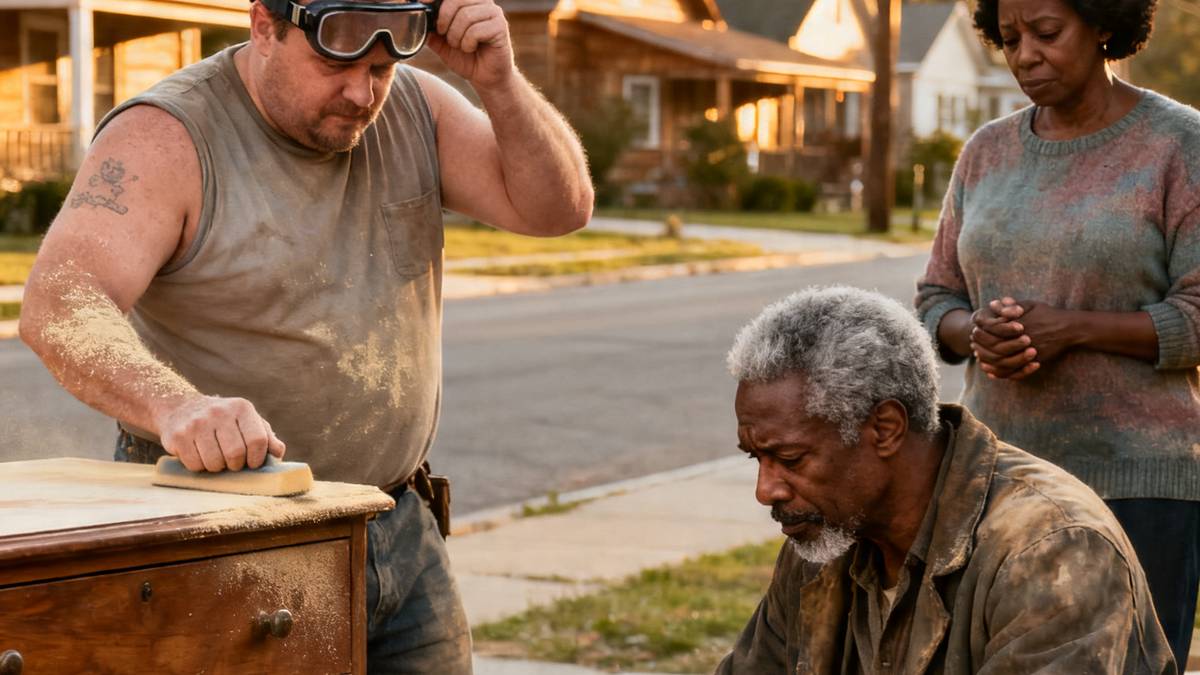
Doris drove to Mike’s house that afternoon. He was in the garage, sanding a dresser he was building for Amanda. Sawdust clung to his arms and the back of his neck. When he saw her, he killed the sander and pulled off his goggles.
“Mom? What’s wrong?”
She walked him into the empty living room and sat him down on a crate. There were no words that softened something like this, so she didn’t try. She told him what Laura had found. The dates. The lie Amanda had been feeding the doctors. The way she’d taken a decision that belonged to both of them and made it into a weapon against him — all while letting him twist in the wind, wondering why they couldn’t conceive.
Mike didn’t react at first. He just stared at the sawdust on his boots. Then a sound came out of him, low and crushed, like a man who’d been holding up a wall and just felt it crack.
He didn’t call Amanda that night. He drove to Cleveland, walked into the clinic just before closing, and asked Laura to show him the records. She did. He stood there in the hallway, running his thumb over the screen, looking at the date stamps like they were photographs of a crime scene.
Amanda came home the next morning. Doris was there. She’d stayed in the guest room, sleepless, and when she heard the front door open, she didn’t move.
Amanda found Mike at the kitchen table with a single piece of paper — a printout from the clinic’s electronic system. He didn’t yell. He just pushed it toward her and said, “Three times. You blamed me to the doctors. You let me believe…” His voice broke. “Did you ever even think about telling me the truth?”
Amanda stood frozen. The color drained from her face, and for a second she looked genuinely afraid, not of him, but of being seen. She tried to reach for him, and he pulled back.
“I did it for us,” she whispered. “A baby would’ve trapped us here forever. I was trying to get us back to the city.”
Mike just stared at her. Something inside him had already shut down. He stood up, walked past her, and got in his truck. He didn’t come back that night, or the next.
Within the month, Amanda had packed her stuff into a moving van. The house stayed empty for a long time. Mike moved into a trailer on his buddy’s property, buried himself in work, and didn’t talk about what happened for almost three years. When he finally started seeing someone — a veterinary tech named Cassie from over in Belden — Doris noticed he didn’t mention marriage. Cassie was patient, quiet, and she never once complained about the trailer’s drip coffee or the mud on her boots.
Two years later, Mike showed up at Doris’s door holding a grainy black-and-white printout. He didn’t say anything, just handed it over. The small white dot on the sonogram seemed to pulse off the page.
“That’s my kid,” he said, and his voice was so steady, so full of something he’d locked away for a decade, that Doris burst into tears.
They held the wedding in the backyard that August. Cassie was four months along and glowing, the kind of glow that didn’t come from makeup. Nobody dropped any rings into any grates, and when the breeze kicked up, the only thing that fell were a few late-summer leaves into the punch bowl.
Mike caught Doris’s eye during the first dance. He didn’t wave or smile. He just nodded, slow and sure, like a man who’d finally stepped out of a long, cold shadow and found the sun waiting.