She was still sitting on the bench an hour after he left, her coffee untouched and cold on the metal armrest beside her. The words kept replaying, the same three sentences on a loop. “This thing with Lisa, it’s not what you think. Actually, it’s exactly what you think.” And then the closer, delivered in that reasonable tone he used for quarterly budget meetings: “We need to call it. Clean break.”
Clean break. Like she was a bone that needed snapping.
Maggie hadn’t screamed or thrown the cappuccino in his face. She’d just watched Sean walk back through the glass doors of the Blackstone Hotel on Fifth Avenue, his shoulders already squared with purpose, a man unburdened. The revolving door swallowed him whole. A minute later, her phone buzzed. Uber Eats refund for the canceled lobster bisque order. The Friday dinner reservation—gone. Even the app knew before she did.
The Puget Sound wind cut through her wool coat, and somewhere down by Pier 62 a ferry horn blared its low, mournful note. Seattle in late October. Everything gray, everything damp, everything ending.
She finally stood up around four-thirty, legs stiff from cold, and walked the twelve blocks back to her Belltown apartment on autopilot. Her key turned in the lock. The scent hit her before the light switch did—his cedar-and-sandalwood candle, still flickering on the entryway console because he’d lit it that morning. That *morning*. He’d lit a candle, kissed her forehead, said “see you at seven,” and already knew he’d be leaving her by three.
The apartment was a museum of him. His Blue Bottle coffee beans by the grinder. His Patagonia fleece draped over the kitchen stool. His stupid electric toothbrush on the bathroom counter, still holding a charge, still ready to be used. She walked from room to room touching things, then pulling her hand back like they were hot. In the refrigerator, a Pyrex dish of last night’s coq au vin. She’d spent two hours on it. He’d said it was the best thing she’d ever made.
Maggie caught her reflection in the dark window above the kitchen sink. Forty-two years old, brown hair pulled back in a clip that had slipped halfway out, mascara smudged under both eyes. She didn’t recognize the expression. Something hollowed-out. Something that had stopped expecting anyone to come back.
Then she placed it.
The dog.
Every morning for the past three weeks, on her walk to the Westlake light rail station, she’d passed a rust-colored mutt lying near the newspaper boxes outside Bartell Drugs. Big brown hound eyes, ribs just visible under a dull copper coat. It never approached anyone, never wagged its tail, never begged. Just watched the commuters stream past like it was waiting for one specific pair of shoes to stop.
She’d noticed it. She’d even thought, *someone should do something about that dog*. Then she’d checked her phone, adjusted her bag, and kept walking. Because she had a life to get to. A boyfriend with dinner plans and weekend hikes and a lease they’d just renewed for another year.
That expression in the dog’s eyes. She’d seen it every morning and hadn’t let herself name it.
Now she was wearing it.
She grabbed her coat, her keys, and the entire Pyrex dish of coq au vin. Didn’t bother transferring it to a container. Just tucked the cold glass dish under her arm and went back out into the drizzle.
—
The dog wasn’t by the newspaper boxes.
Maggie stood on the corner of Fourth and Pine, rain beading on her shoulders, scanning every doorway and alley entrance. Nothing. She walked the block three times, then expanded her search radius—down to the Target entrance, past the closed teriyaki shop, along the bus shelter where a guy with a guitar was playing “Landslide” badly.
Half an hour. Forty minutes. The dish was getting heavy and her fingers were going numb.
“Come on,” she whispered, her voice cracking. “Where are you?”
She almost gave up. Almost went home to the candle and the empty apartment and the coq au vin she’d never eat alone. But there was something about the emptiness that felt like quicksand, and if she stopped moving, she’d go under.
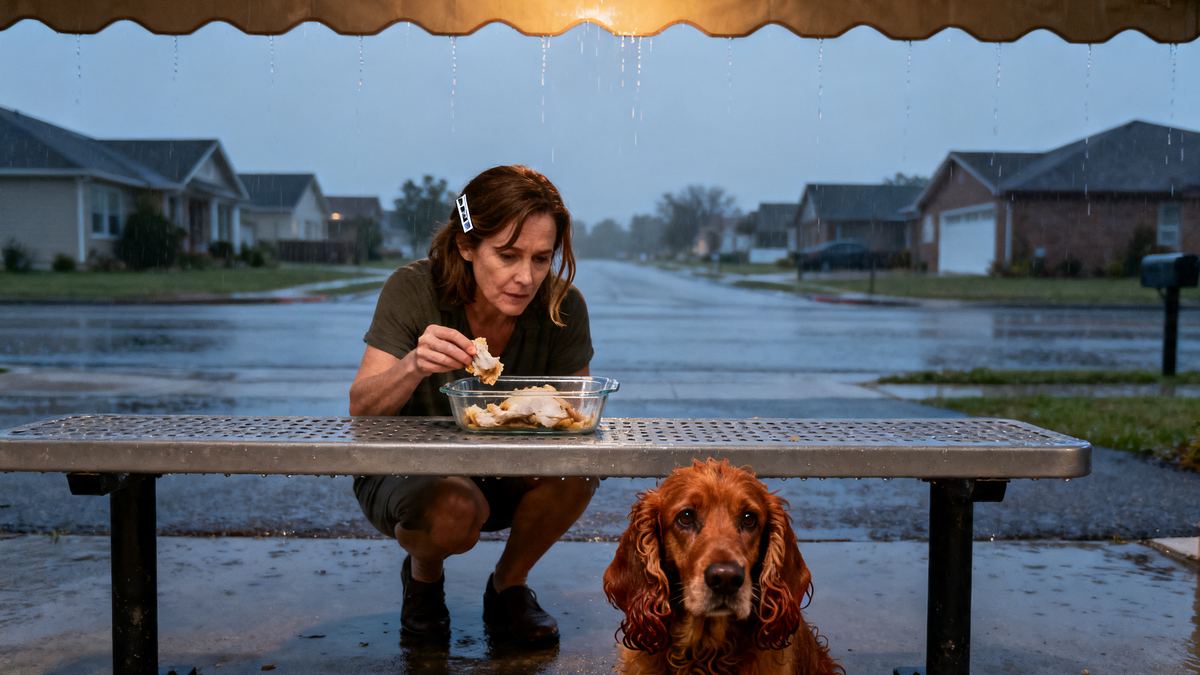
She circled back to the Walgreens on Third—one block over from where she usually saw it—and there, tucked under a steel bench by the parking pay station, was a curled-up ball of wet copper fur.
The dog lifted its head.
Maggie stopped breathing.
Those eyes. That exact same look she’d caught in her own reflection. Not sad, exactly. Sad was too simple. This was bewilderment. The look of a creature who’d given everything it knew how to give and had still ended up alone on cold concrete.
She crouched down, setting the Pyrex dish on the sidewalk. The dog flinched but didn’t run.
“Hey,” Maggie said. Her voice came out raw. “Hey, I know that look. That look is *bullshit*.”
The dog’s ears twitched.
She pulled the lid off the dish. Steam rose in the cold air—still faintly warm from the apartment. She tore off a chunk of chicken with her fingers and held it out.
“I’m not gonna pretend I’m some hero here. I had a really bad day. The worst day, actually.” The words were just falling out now, and she didn’t care that she was kneeling on wet pavement talking to a stray. “The guy I thought I was gonna marry decided to go back to his ex-wife. Told me over coffee like it was a performance review. I sat on a bench for three hours because I couldn’t remember how to stand up.”
The dog watched her hand. Watched her face. Didn’t move.
“And I realized,” Maggie continued, “that I don’t have anyone to call. I gave him *everyone*. My friends, my weekends, my whole calendar. I stopped showing up anywhere he wasn’t.” She laughed, a hollow little sound. “I even stopped *seeing* you. Three weeks, you’ve been right there, and I just walked past. So I’m sorry. I’m really sorry.”
The dog stood up.
Slowly, stiffly—one back leg seemed to give it trouble—it stepped out from under the bench and sniffed the air. The chicken. The rain. The woman.
It took one step closer. Then another.
Maggie held absolutely still, her arm outstretched, chicken trembling in her fingers. The dog stretched its neck and took the meat so gently she barely felt the teeth.
It didn’t retreat after swallowing. It looked up at her and made a sound—not a whine, not a bark. Something in between. Something that said, *I’ve been waiting for one pair of shoes to stop, and yours finally did.*
“You want to come home?” Maggie whispered. “I have a couch and central heating and an ex-boyfriend’s toothbrush I’m about to throw in the trash. The spot’s open.”
The dog tilted its head.
“No pressure. I’m a stranger. Strangers are the worst.” She sat back on her heels, rain dripping off the end of her nose. “But I could really use someone who gets it.”
For a long moment, nothing happened. The dog stood frozen, caught in whatever internal calculus stray animals perform when deciding whether a human is worth the risk. The streetlight above them flickered on as dusk deepened. The bus rumbled past, spraying water.
Then the dog walked forward, past the chicken, past the dish, and pressed its cold, wet nose against Maggie’s knee.
She burst into tears.
Not delicate crying. Not the restrained, silent tears she’d held back at the hotel. The ugly kind—the kind where your shoulders shake and your breath comes in gulps and you make sounds you didn’t know you could make. She wrapped her arms around the dog’s damp, bony body and buried her face in its neck, and the dog let her. The dog leaned in.
They stayed like that on the sidewalk outside Walgreens while the city swirled around them—commuters stepping past, a guy on a bike ringing his bell, the Fleet Foxes song drifting from a car at the stoplight. Nobody stopped. Nobody needed to.
—
Maggie named her Rudy. Roo for short, because of the way her back legs splayed out when she lay on the hardwood floor, like a kangaroo.
The first week was hard. Rudy had trust issues that didn’t dissolve with one chicken dinner. She flinched at sudden movements, hid under the coffee table when Maggie grabbed a broom, and refused to eat until Maggie stepped back three feet and turned away. But every night, around nine o’clock, Rudy would inch onto the couch and place her head on Maggie’s thigh, and they’d sit like that in the quiet apartment until one of them fell asleep.
The vet said Rudy was probably four years old. A hound-lab mix. Healthy, despite the ribs. The limp was an old injury that had healed wrong. “She’s been on her own a while,” the vet said, rubbing Rudy’s ears. “You can always tell. They’ve got a different way of looking at the world.”
*I know*, Maggie thought. *I’ve got it too now.*
Sean called twice. The first time, she let it ring. The second time, she answered from her spot on the couch, Rudy’s head heavy on her lap.
“Maggie, look, I feel terrible about how that went down. Can we at least talk civilly about the lease?”
She looked around the apartment. His things were gone now. She’d boxed them up the morning after Rudy came home and left them with the building’s front desk. The candle was in the trash. The toothbrush was in the trash. The only thing left was the dent in the left side of the mattress, and that would fade eventually.
“The lease is handled,” she said. “I’m keeping the apartment. You’re off the paperwork as of yesterday.”
“Wait—how did you—”
“You made it a clean break, remember?” She scratched behind Rudy’s ears. The dog’s tail thumped once against the cushion. “I’m just honoring your wishes.”
She hung up before he could answer.
—
By Christmas, Rudy had gained nine pounds. She no longer flinched at the broom, and she’d claimed the armchair by the window as her permanent throne. Maggie had started running again—short loops around Myrtle Edwards Park, Rudy panting happily beside her, the limp less pronounced now with regular movement and good food.
On New Year’s Eve, Maggie didn’t go to any of the three parties she’d been half-invited to. She made a charcuterie board for one, opened a bottle of Malbec, and sat on the floor with Rudy, feeding her bites of Manchego between sips of wine.
At midnight, fireworks exploded over Elliott Bay.
Rudy scrambled into Maggie’s lap—all forty-eight pounds of her—shaking at the booms and cracks. Maggie wrapped both arms around her and held tight, her chin resting on Rudy’s warm head.
And for the first time since the afternoon at the Blackstone Hotel, the hollow feeling wasn’t hollow anymore. It was just a scar. Still there. Still tender if she pressed on it. But sealed over, filled in with something new.
She didn’t make resolutions. She didn’t promise herself anything grandiose about the coming year. She just sat on the floor with her dog, watching the lights burst red and gold over the water, and let herself be exactly where she was.
Rudy licked the inside of her wrist.
Maggie laughed and reached for another piece of cheese.