
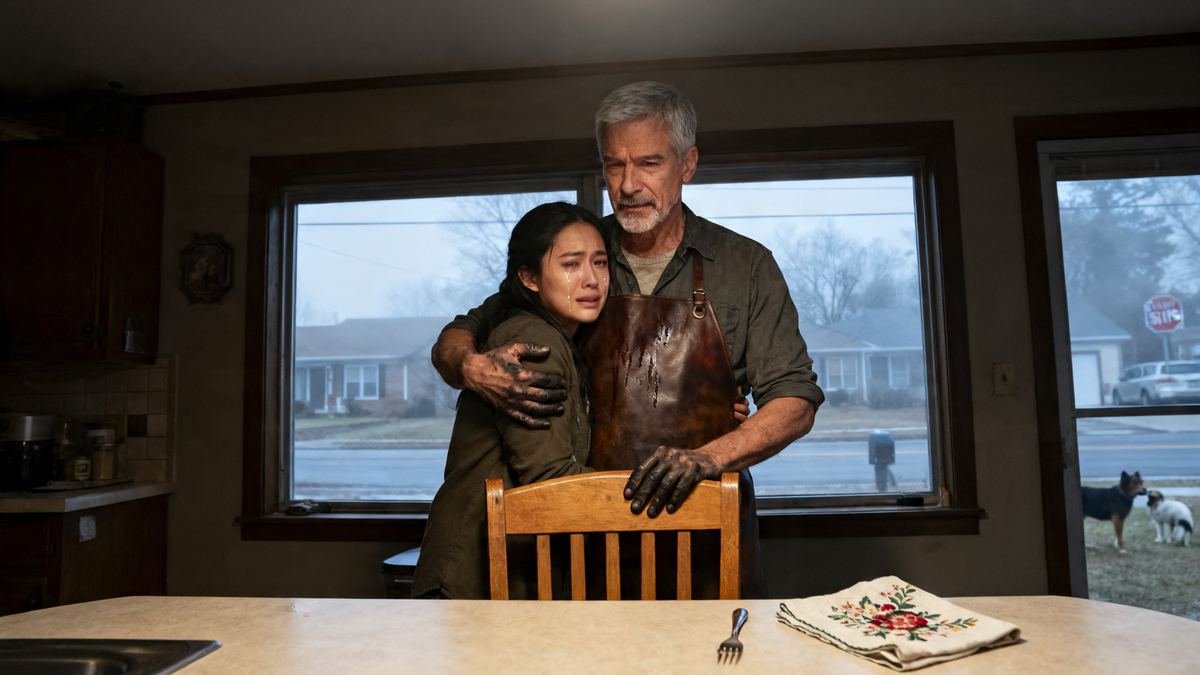
The silver fork clattered against the china plate, and the warm kitchen suddenly felt like a walk-in freezer. My daughter Emma stared down at the tablecloth, her knuckles white around the embroidered napkin her mother had made years ago.
“He promised me Harvard,” she whispered. “All four years. Plus a condo in Cambridge.”
“Who?” My voice came out like gravel.
“Richard Sterling.”
The name landed like a punch to the chest. Sterling. The man whose handmade Italian loafers I’d been polishing for six years. The real estate tycoon who tossed me a twenty every visit like I was a parking meter. The guy who never once looked me in the eye.
I set down my fork. My hands—stained from polish, rough as sandpaper—didn’t feel like mine right then.
“Emma, that man—”
“He told me everything.” She looked up, tears spilling. “He said Mom hid me from him. That she ran off and he tried to find us for years. He had letters from her, Dad. Photocopies of letters where she said she wanted nothing to do with him.”
“Those are lies.”
“Then why do the letters exist?” Her voice cracked. “He showed me a DNA test. He wants to officially recognize me as his daughter. He’s got lawyers drawing up paperwork tonight. I’m supposed to sign tomorrow morning.”
I stared at her. This girl I’d raised since she was two. I taught her to ride a bike behind the shop. I braided her hair every morning after her mother passed. I took out a second mortgage on the house last month just to scrape together her first semester at whatever college would take her.
“Your mother begged him for help,” I said. “When you were a baby. He told her to get an abortion. When she refused, he changed his number and vanished. I was there. I bought your diapers while she worked double shifts.”
“But Harvard, Dad.” She was crying now, shoulders shaking. “You’re killing yourself. I saw the papers on your desk. You were going to put the shop up. I won’t let you lose everything because of me.”
I walked around the table and pulled her in. Her hair smelled like rosemary soap, and her tears soaked through my shirt.
“Sweetheart. You didn’t have to do this.”
“He’s waiting for me at nine,” she said into my shoulder. “His office downtown. He’ll wire the first semester the minute I sign.”
I held her tighter. And I thought about the shoe box under my bed.
—
The next morning, fog ate the city. Sterling Tower loomed over the financial district, all steel and black glass. I walked into the lobby wearing my leather apron—the one with wax stains and polish smears I’d never bothered to wash out—and carrying an old satchel.
The elevator slid open on the forty-first floor. Emma was already there, perched on a leather couch in Sterling’s corner office, pale, her fingers locked together in her lap. Sterling sat behind a slab of black glass on chrome legs, two suits flanking him.
“Well, well,” Sterling said, flashing a grin. “The shoe repairman. Come to negotiate a finder’s fee?”
I set the satchel on his desk, right on top of a presentation folder with HARVARD embossed on the cover.
“I’m not here for money.”
“Then what’s that?”
I unbuckled the flap and pulled out a stack of yellowed envelopes, a microcassette in a clear case, and a legal-sized document sealed in plastic.
“Claire’s file. Your old girlfriend. Remember her? Tall, red hair, the woman you paid off and then threatened into silence twelve years ago.”
Sterling’s face went slack. His lawyers exchanged a glance.
“Dad, what are you doing?” Emma stood, her voice shaky.
I held up the cassette. “This is from our answering machine. March fourteenth, the year Emma was one. You called because Claire wrote you a letter asking you to set up a trust. You told your secretary to throw her out of the building. And then you said, right here on tape: ‘That kid is dead to me. Same as you.’ Claire saved it. Made me promise not to use it unless you came sniffing around.”
“That’s a fabrication,” Sterling snapped.
I unfolded the document. “Notarized agreement. You paid her fifty grand to sign over full custody to any future husband of hers. You erased yourself. But when you found out she was marrying me—some guy who fixes shoes—you panicked. You sent her these.” I tossed a printout on the desk. The header read rs@sterlingprop.com. *If you ever tell anyone this child is mine, I’ll make sure you regret it. Keep your mouth shut or I’ll destroy you.*
Emma snatched the page. Her eyes flew over the words. She looked up at Sterling, then back at the paper, her mouth opening and closing without sound.
“All lies,” Sterling said, but his voice had lost its polish. “She was unstable—”
“And the tape?” I said. “Voice recognition’s a phone call away. You want to explain that to a judge?”
The room went quiet. One of the lawyers actually stepped back.
Emma turned to Sterling. “You told me Mom kept me hidden out of spite. But you threw us away.”
Sterling rounded the desk, hands out. “Emma, listen. I was young. Scared. My father would’ve disowned me. I’m different now. I can give you everything—Harvard, a car, the condo. This man here can’t even afford a hot meal. Look at his hands.”
Emma looked at my hands. They were stained dark around the nails, knuckles swollen from thirty years of stitching and hammering. When she was seven and fell off her bike behind the shop, those hands had scooped her up and carried her two miles to the ER. That was the only time I’d ever run fast.
She turned back to Sterling. She grabbed the folder of documents he’d prepared—the name change, the paternity claim, the whole glossy packet—and hurled it straight into his chest. The pages smacked his shirtfront and fluttered up like a flock of panicked pigeons.
“I don’t want your money,” she said. “I don’t want your name. I’d rather work nights at a diner than take a dime from a man who called me dead before I could walk.”
She grabbed my hand. “Come on, Dad. Let’s go home. I think there’s still some of that cheesy casserole left.”
We walked out through the fog. Her grip was tight, just like crossing the street when she was little.
—
Two weeks later, a thick envelope arrived from Boston University. Emma had applied in secret months before. Inside was an acceptance letter and a financial aid package—generous, but it still left a gap of about seven thousand dollars.
I stood at the kitchen counter, reading the number over her shoulder. She was already calculating work-study hours and loans, her finger tapping the table. I didn’t say anything. Later that night, I pulled my father’s violin case from under the bed and lifted the lid. The rosin dust still smelled like his workshop. I latched it shut and set it by the front door.
The next morning, Emma caught me wrapping the case in brown paper for the antique music shop on Tremont.
“Dad. That’s Grandpa’s.”
“It’s just wood and strings,” I said, not looking up.
She put her hand over mine. For a long moment neither of us spoke. Then she said, “I can work summers. I’ll take the five a.m. shift at the bakery. You don’t have to—”
“You’re going to college,” I said. “We’ll figure the rest out.”
That evening she danced around the tiny kitchen with the letter in her hand, socks sliding on the linoleum, laughing so loud the neighbor banged on the wall. She cupped her mouth and hollered, “It’s a happy noise, Mrs. Kowalski!” and kept spinning, and I swear the room felt warmer than it had in years.