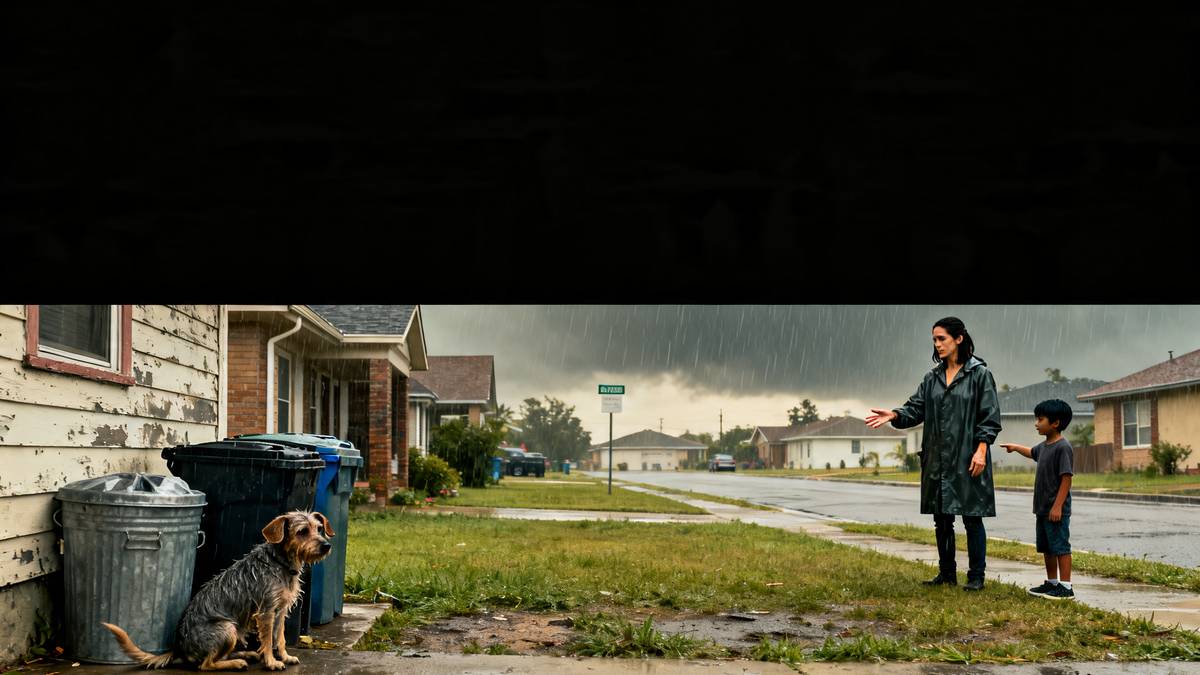
The wind was already picking up, rattling the loose shutter on the old porch, when I first saw him. A scrap of matted fur, soaked to the bone, huddled against the garbage bins by the side of the house.
My eight-year-old son, Leo, spotted him a half-second later. He dropped his juice box on the gravel and pointed. “Mom. Mom, look. He’s all alone.”
He was. We were three hours outside Chicago, deep in the Illinois countryside, on a property my late aunt had left us that needed more work than my bank account wanted to admit. The nearest neighbor was a cornfield and a prayer away. No collar. No tags. Just a quivering little body in a thunderstorm that was about to get biblical.
“Can we keep him?” Leo whispered, already knowing the answer.
“No, baby. We can’t.”
This was not a new conversation. We had been having it for two years, ever since my son figured out that a dog was the missing piece of the universe. Every birthday, every Christmas list, every time we passed a pet store. The answer was always the same. What my son didn’t know, what I had never told him, was why.
Leo was three when I lost Shadow. Shadow was a black Lab mix I got in college, long before I met my ex-husband, long before the marriage fell apart in a mess of custody schedules and unspoken resentments. Shadow was the one who lay on my feet during late-night feedings. Who guarded the crib like a furry sentinel. Who looked at me with those amber eyes that said, *I’ve got you*.
And then one Tuesday, my ex left the side gate open. Shadow chased a rabbit. The pickup truck on Ashland Avenue didn’t even have time to brake. I got the call while Leo was napping. I held it together until my mother arrived, then I sat in the garage with the engine off and screamed until my throat bled.
I never told Leo the details. He was too young to remember Shadow. And I swore, right there in that cold garage, that I would never let another animal break my heart like that. The love wasn’t worth the crater it left behind.
So no. We couldn’t keep the stray.
But the storm was rolling in fast, a wall of black clouds and strobing lightning. I wasn’t a monster.
“Grab the old towels from the laundry basket,” I said. “He stays in the mudroom tonight. That’s it.”
Leo’s face lit up like the Fourth of July.
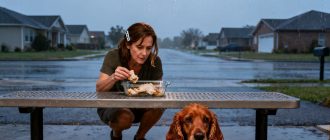
We named him Gus, because Leo said he looked like a dusty old man with his gray-brown fur and tired eyes. He was a terrier mix of some kind, maybe six months old, ribs visible under the wet fur. I fed him leftover rotisserie chicken from the cooler, and he took it from my fingers so gently it made my chest ache.
The next morning, I drove twenty minutes into the nearest town, Rock Creek, and posted photos on every local lost-pet group I could find. I called the shelter. I did my due diligence. Nobody claimed him.
Leo spent every waking moment with Gus. The two of them explored the overgrown orchard out back. Leo read him chapters from *Dog Man* on the creaky porch swing. At night, Gus would whine until I let him sleep on the braided rug beside Leo’s camp cot.
And me? I kept my distance. I fed him because that was the decent thing to do. I checked him for ticks. I didn’t let myself look him in the eye for too long. I’d seen that look before. The one that says, *I trust you. Don’t let me down*.
My mother drove up the second weekend to help us clear out the attic. She took one look at Leo and Gus wrestling in the yard, then turned to me with that knowing, infuriating maternal radar.
“You’re in trouble, Jenny.”
“I know.”
“But you’re still going to say no.”
“I can’t go through it again, Mom. I can’t.”
She didn’t push. She just squeezed my arm and went inside. But the seed was planted, and it grew thorns.
By the end of August, the house was almost livable. The roof was patched, the water heater was no longer possessed, and the kitchen cabinets had been scrubbed of thirty years of mouse droppings. We were due back in the city Tuesday morning. School started the following week.
The dread started creeping in around Thursday. Every time Leo hugged Gus, every time he whispered “I’m gonna miss you so much, buddy,” the knot in my stomach twisted tighter. I caught myself scanning the online classifieds for no-kill rescues, for foster families, for any solution that didn’t end with me staring at an empty dog bed for the next decade.
I didn’t sleep Sunday night. At three in the morning, I gave up and went to the kitchen. Gus padded in behind me, nails clicking on the linoleum. He sat down by the back door and just watched me, tail giving a hesitant little thump.
“Don’t look at me like that,” I muttered. “I’m not your person.”
He tilted his head. The tail thumped again.
I made coffee and sat on the back steps, watching the sky go pink over the cornfields. Gus lay down beside me, his warm flank pressed against my hip. Without thinking, my hand found the spot behind his ear, and his eyes closed in pure, uncomplicated bliss.
That was the moment I almost caved. Almost.
But then the image came, unbidden—Shadow on the asphalt, the blood, the way the vet’s face looked when she came out to tell me they couldn’t save him. The fissure in my chest that had taken years to scab over. I pulled my hand back.
“No,” I said out loud. “I can’t.”
The decision felt like swallowing a stone.
I told Leo we couldn’t take Gus home. I gave him the sanitized, adult version—we lived in a condo with no yard, I worked long hours, it wasn’t fair to the dog, it wasn’t fair to *him*. He cried. He begged. He made PowerPoint-level arguments about dog walkers and doggy daycare and his friend Mason whose mom had a dog *and* a job. I held firm. I was a wall. A cold, unfeeling, reasonable wall.
We were leaving Tuesday morning at seven sharp. I told Leo to say goodbye to Gus before bed. He did. He sat on the mudroom floor with the dog in his lap for two hours, sobbing quietly, and I stood in the hallway with my hand clamped over my mouth because I didn’t trust myself not to howl.
That night, the storm came back.
It was worse than before—wind that made the old house groan, rain hitting the windows in sideways sheets. I woke up around two to a crash somewhere outside. Leo was still asleep, dead to the world. I pulled on my boots and a raincoat and went to check the damage.
The side gate was open. Swinging wildly on its hinges.
And Gus was gone.
I ran. I don’t know why, because this was the plan, right? The dog was loose, the dog was gone, problem solved. But I ran anyway, flashlight beam cutting through the rain, screaming his name into the howling dark. My boots sank into the mud. Branches slapped my face. I couldn’t see anything beyond ten feet.
“Gus! Gus, come here!”
Nothing. Just the storm and the sick realization that I was about to lose another one.
Then I heard it. A whimper. Faint, desperate, coming from the drainage ditch at the edge of the property. I slid down the embankment, mud and rocks giving way under my feet, and there he was. Gus was tangled in a mess of brambles and barbed wire, one paw twisted at an ugly angle, shivering so hard his whole body shook.
“Hey, hey, it’s okay. I’ve got you. I’ve got you, buddy.”
I said it over and over as I freed him, as I wrapped him in my ruined raincoat and carried him back to the house. I said it in the car when I drove forty miles an hour through flooded back roads to the twenty-four-hour emergency vet in Beloit. I said it in the waiting room, covered in mud and blood and rain, while the techs gently took him from my arms.
And somewhere in that cold, fluorescent-lit hallway, with my heart hammering against my ribs and my hands still matted with his fur, I realized the truth.
The scab was gone. He had gotten in. And if someone couldn’t save him, the crater this time would be just as deep. Maybe deeper.
It was dawn when the vet finally came out. Dr. Okonkwo, a calm woman in bright pink scrubs, smiled at me.
“He’s going to be fine. A dislocated shoulder and some deep lacerations on the paw, but no permanent damage. He’ll need a few weeks of rest. Do you know his owner? There’s no microchip.”
I opened my mouth to say *no*. To explain the lost-pet ads, the shelter calls, the whole complicated saga. But what came out was something else entirely.
“I’m his owner. I’m Jenny. And his name is Gus.”
She didn’t even blink. Just nodded and handed me a clipboard with the paperwork.
I called my mother from the parking lot. “I’m keeping him.”
She was quiet for a long moment. Then, softly, “Oh, honey. I’m so glad.”
Leo woke up at the house to an empty mudroom. By the time I got back, he was sitting on the front steps, face blotchy and swollen, looking out at the road like he could will the dog back into existence. I pulled into the driveway with Gus curled up on the passenger seat, his leg wrapped in a bright blue bandage.
Leo saw us through the windshield. He didn’t run. He didn’t scream. He just stood up, real slow, and walked toward the car with the most fragile, disbelieving hope I had ever seen on a human face.
I rolled down the window. “So,” I said. “Turns out we have a dog now.”
Leo opened the car door and climbed in so carefully, so gently, like Gus was made of spun glass. He pressed his forehead to the dog’s muzzle and whispered three words that cracked my heart right open.
“He came back.”
Later that afternoon, I sat on the back steps again, watching my son and my dog limp around the yard together, Gus’s tail wagging furiously despite the bandage. The storm had passed. The air was clean and cool, and the sun was warm on my face.
I thought about Shadow. I thought about all the years I spent guarding a wound that would probably never fully heal. I thought about how love isn’t a door you can lock because you’re afraid of who might leave. Gus was going to break my heart someday. That was the contract. Every single one of them does.
But standing there, listening to my son giggle as a scruffy little terrier licked the inside of his ear, I figured it was a price I was finally willing to pay.
Leo looked up and caught me watching. He grinned, wide and gap-toothed, holding Gus’s good paw up like a trophy.
“Mom! He just did the thing! The head-tilt thing!”
“I saw,” I said. “I saw the whole thing.”