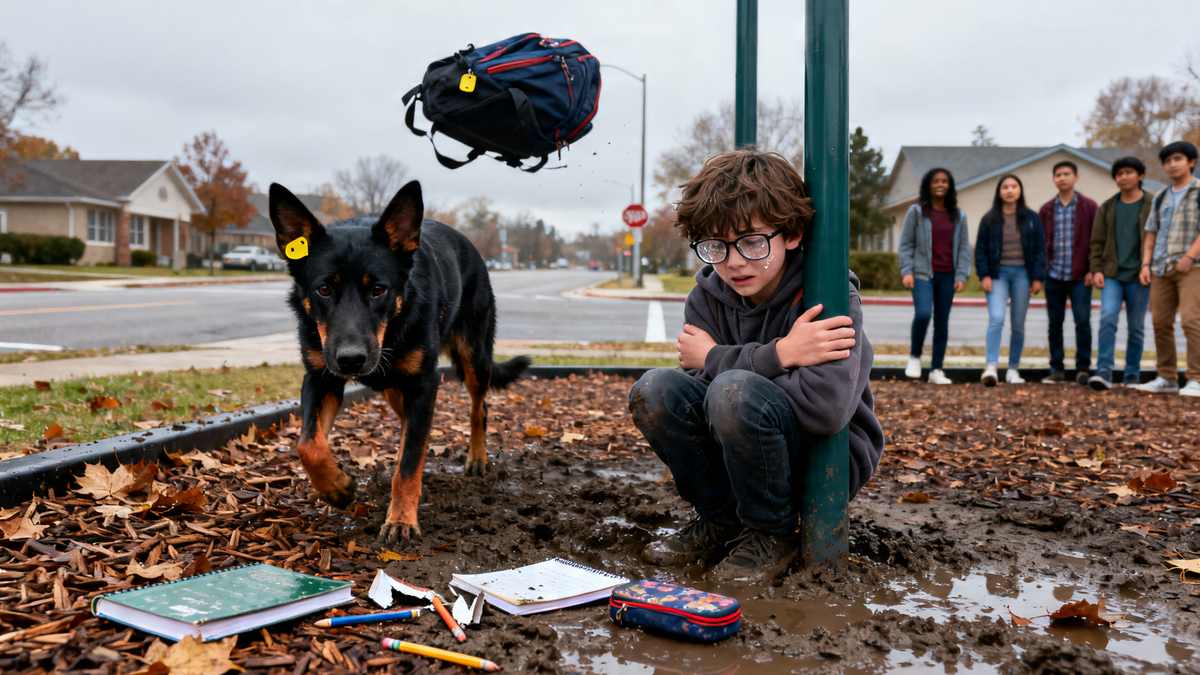
Leo Parker pressed his back against the cold metal leg of the jungle gym, his knees drawn up so tight his stomach hurt. He was crying, ugly, hiccuping sobs he couldn’t stop, the kind that made his glasses fog up until the whole world was a blur of gray November sky and wet orange leaves. His backpack—a Star Wars one his mom got on sale at Target—was still airborne, flipping end over end after Kyle ripped it off his shoulder. Textbooks and a half-broken pencil case exploded across the woodchips, followed by his math binder, pages of carefully written-out equations spinning into mud.
“Roly-poly Leo, gonna cry again?” Kyle’s voice cut through the ringing in his ears. Danny and Marcus laughed somewhere behind him, their sneakers grinding a notebook into the dirt.
Leo didn’t answer. He just tucked his chin and waited. He was eleven, five-foot-nothing, soft around the middle and terrible at dodgeball. He wore thrift-store jeans and a hoodie stained with yesterday’s chocolate milk. Nobody was coming to save him. Ever.
Then a sound cut through the laughter—low, gravelly, and completely not human. A growl that seemed to come from the ground itself.
Leo blinked through wet lashes. A huge black dog with jagged rust-colored patches across her ribs had materialized between him and Kyle. She didn’t bark. She just planted herself, legs stiff, head low, and peeled her lips back over very white teeth. The yellow plastic tag clipped into her ear—the kind the county animal control used for strays—shivered with the rumble in her chest.
Kyle stumbled backward, tripping over his own feet. “What the—that thing’s rabid!”
The dog lunged two steps. Kyle, Danny, and Marcus decided the rest of their afternoon could be spent somewhere else. They ran.
Leo couldn’t move. The dog turned. Her tail, which had been a rigid black flag, dipped low and began to wag, slowly at first, then faster, thumping rhythmically against a post. She walked toward him, right past his scattered homework, and pushed her wet nose into his hand.
He flinched. Then he touched her. The fur on her head was rough and short and warm. “Hey,” Leo whispered. “Hey, you… you’re not gonna bite me, are you?”
The dog licked his wrist. Her eyes were dark and calm and almost laughing at him. Then she turned, trotted to the nearest textbook, and carried it back in her mouth, dropping it on his shoes like it was the most obvious thing in the world.
They gathered the rest together. A chunky boy in glasses and a stray with a yellow tag. By the time Leo’s backpack was zipped shut, the dog had leaned hard against his leg, her shoulder pressing into his hip, and Leo didn’t feel quite so alone.
—
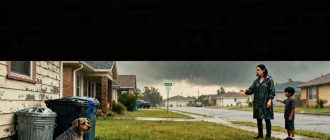
His parents didn’t get it. Mom, Sarah, was folding laundry in the living room when he came home with twigs in his hair and the smell of dog on everything. He tried to explain, his voice going higher and faster the way it always did when he was scared they’d say no. A dog. A friend. She saved me. Can we—
“Absolutely not.” David, his father, didn’t even look up from his laptop. “We’ve been over this. No yard, no time, no money for vet bills. And you can’t just bring home a stray.”
“But she’s got a tag, she’s a county dog, she’s not sick—”
“Leo.” His mother’s voice was softer, but final. “We’re sorry. Go wash up.”
That night Leo lay in bed, staring at the crack in the ceiling, and decided he would never mention her again. Not to them. Not to anyone.
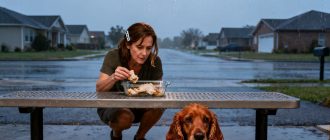
But every day after school, the dog was there. Waiting by the same leg of the jungle gym, her tail sweeping the woodchips. Leo started saving half his lunch—chicken nuggets, apple slices, the turkey from his sandwich. He smuggled out slices of cheese and Ziploc bags of dry kibble he’d bought with his own allowance at the corner store.
A month went by. He stopped crying after the last bell. Kyle and his crew gave him a wide berth now, eyeing the black shadow that walked him to the edge of the schoolyard. His backpack was still dirty, but only from the two of them wrestling in the leaves, and the scabs on his palms weren’t from bullies—they were from the monkey bars, which he was finally beginning to climb. The black dog would sit underneath, watching him with her steady, bright eyes, and every time his fingers slipped, she’d yelp once, short and sharp, like she was trying to cheer him on.
His mom noticed something had shifted. Leo was hungrier at dinner. His cheeks were less pale, the circles under his eyes fading. He came home with dirt on his knees and didn’t flinch when she touched him. One morning, Sarah watched him pack an extra granola bar into his backpack, a smile flickering at the corner of his mouth.
“Who’s that for?” she asked.
Leo’s smile vanished. “Nobody. For me.”
She didn’t push. But that evening, when David came home, she told him, “Something’s different with Leo. A good different. I think I need to follow him tomorrow.”
David shrugged. “He’s a kid. Let him have his secrets.”
She planned to, anyway. Planned to call in sick from the dental office where she worked and trail her son at a distance. But the next day, everything went wrong before she got the chance.
—
Leo was walking home from school, a tennis ball in his hand that he’d found on the soccer field. The dog—he still had no name for her, just called her “pup” or “good girl” or sometimes, in his head, “you” like she was a single word that meant everything—bounded ahead, twisting in midair to catch the ball before it even bounced. He laughed, the sound pure and unguarded in the cold air. He threw it farther. She ran.
She never reached it.
There was a noise that Leo would later replay in his nightmares: the screech of tires, the thud of something solid hitting metal, and the sound she made—a single high-pitched cry that cut off too fast.
He couldn’t remember running. He was just there, crumpled in the middle of the street, his hands shaking as they pressed against her side. She was lying in a weird, wrong way, her chest rising and falling too shallowly. Blood matted the rust-colored patches on her ribs, and the tennis ball, half-chewed, was now streaked with red.
“No, no, no—please—Friend, please.” Leo’s voice broke. He lifted her head, so heavy and slack, into his lap. “You’re okay, you’re gonna be okay—”
A car door slammed. A man in a grey suit was suddenly kneeling next to him, phone in hand, face pale. “Kid, I’m so sorry, I didn’t see her—she came out of nowhere—are you hurt? Is she—?”
“Pick her up,” Leo said. It came out calm, too calm for a fifth grader sitting in his own dog’s blood. “Help me. Get the car. There’s a vet on Sycamore, I know where it is.”
The man hesitated, probably because moving an injured animal was a bad idea, but Leo’s face must have said something else. Together they lifted her—the dog was heavy, dead weight, and Leo’s arms screamed—into the back seat of the sedan. Leo climbed in after her and held her head steady, whispering nonsense into her ear until the world outside the window became a blur of streetlights and the vet clinic’s neon sign swam into view.
—
Leo’s parents got the call at four o’clock. They arrived to find their son sitting on the floor of a waiting room that smelled like antiseptic and wet fur, his hands balled into fists on the knees of his jeans. The front of his hoodie was dark and stiff. The grey-suited man was pacing, on the verge of tears himself.
“Are you the parents? I’m so sorry, I didn’t even see her—she pushed him out of the way, the kid woulda been hit if she didn’t jump—”
Sarah ignored him. She dropped into a crouch in front of Leo and cupped his face. “Baby. Are you hurt?”
Leo stared at her without focus. “They took her back there. She’s bleeding inside, the doctor said. She needs surgery, Mom. I gave them my phone and all my birthday money, I tried—they said it’s not enough—” A sob tore out of him, raw and desperate. “I have a Nintendo Switch. I can sell it. And Grandma gave me a hundred dollars I hid in my drawer—and I was gonna use it for a dog house, because winter’s coming, and she can’t stay outside without a house, and I know I wasn’t supposed to, but she’s my friend—she’s the only one who—”
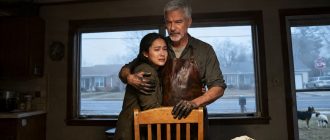
“Stop. Leo, stop.” Sarah pulled him against her, hard, and over his shoulder she caught David’s eye. David’s jaw was working, his eyes wet, and he gave one tight nod.
A veterinarian in green scrubs came through the double doors. “Mr. and Mrs. Parker? She’s stable. Lacerated liver, broken ribs, but the surgery went well. She’ll need weeks of rest and medication. Given the ear tag, she’s a stray with a county shelter record. We need to contact animal control to confirm her status and release her to you.”
“Do it,” David said, his voice rough as gravel. He stepped forward, his hand landing on Leo’s shoulder. “She’s not going anywhere. She’s ours.”
The vet nodded, already pulling out his phone. “I’ll call right now. With your permission, I can start the adoption process while I’m at it.” He stepped to the side, and a short phone conversation brought muffled confirmation: the dog had no chip, no owner claims, and the county was happy to release her into the Parker family’s custody pending signed paperwork. Minutes later, Sarah signed a form at the counter, and the vet clipped the yellow tag from the dog’s ear with a small pair of pliers, dropping it into a stainless steel tray.
An hour later, Leo sat on a metal folding chair, exhaustion hollowing out his bones. His mother was beside him, an arm draped over his shoulders. His father was at the front desk, filling out the final pages with a credit card he hadn’t fished out of his wallet in years.
The vet came back, and this time he was smiling. He knelt in front of Leo and opened his palm. In it lay a small, bright-yellow square of plastic, the edges slightly dulled. 345.
“She’s waking up. She’ll be groggy, but you can see her now.”
Leo took the tag. He curled his fingers around it so tightly the edges bit into his skin. He walked into the back room with his parents flanking him, toward a metal table where a black dog with a shaved, bandaged side lay blinking against the fluorescent light. Her tail thumped once, twice, weakly, against the table.
Leo touched her nose. She licked his finger.
“I’m sorry I never gave you a real name,” he whispered.
David rested a hand on the back of Leo’s neck. “You already did.”
He nodded toward a form on the counter, the intake paperwork the vet had filled out where it asked for the patient’s name. One word. The word Leo had been screaming since they’d arrived.
Friend.
—
Three weeks later, on a snow-dusted December morning, Leo sat on the living room floor in front of a giant memory foam dog bed. Friend was sprawled across it, a new blue collar around her neck with a gleaming silver bone tag that read: FRIEND — PARKER FAMILY, with their address and number on the back. She was still thin, her movement a little too careful, but her eyes were bright and clear and locked on the tennis ball in Leo’s hand.
“Not yet, goofball,” Leo said. “Vet said no running for another week.”
Friend whined, low and dramatic.
From the kitchen, Sarah called, “Leo, did you finish your math packet?”
“Almost.”
“Almost means no. Get it done first, then you can do your lazy toss in the backyard.”
Leo groaned but pushed himself up. Friend immediately shifted her head onto her paws, the picture of patient suffering. He bent down, kissed the top of her scarred head, and felt the steady thump of her tail against the bed frame. He slid the old yellow ear tag out of his pocket—he carried it everywhere now—and rubbed his thumb over the number.
He didn’t have to carry it anymore. But he would.
Later that afternoon, he sat at the kitchen table, pencil in hand, with Friend’s head resting on his foot. His dad came in, poured a cup of coffee, and glanced at the open math binder.
“You know,” David said, “when I was your age, I hated math too. Couldn’t stand it.”
Leo looked up. “Mom said you failed algebra.”
“I did. Want to see how the quadratic formula really works? It’s not as bad once you see the trick.”
He pulled out the chair next to Leo, picked up a pencil, and wrote an equation in the margin with slow, careful strokes. Leo leaned in, his frown fading. Friend yawned noisily, stretched one paw, and fell back asleep against his shoe.
Outside, the snow kept falling, quiet and steady, and inside the scratch of two pencils filled the room. The tennis ball sat on the windowsill, waiting for warmer days, and beneath the table, a black-and-rust tail gave one lazy thump and then went still.