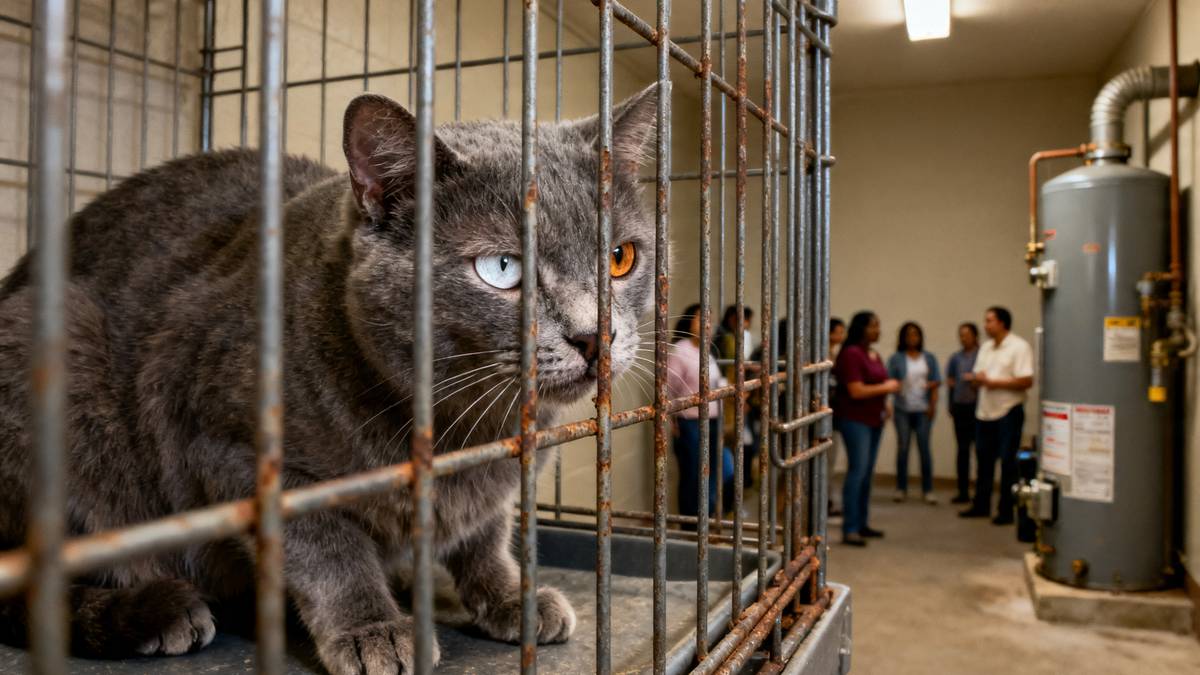
The cat came back in a cardboard carrier that had seen better days. The man who handed it over didn’t even bother to take off his sunglasses. “He’s half blind,” he said, tapping his temple. “Keeps bumping into the furniture, can’t find the litter box half the time. I don’t have the patience for a defective animal.”
Susan, the morning-shift manager at Second Chance Shelter, bit the inside of her cheek and took the carrier without a word. She set it on the exam table and unlatched the little door. A massive gray tomcat crept out, his whiskers twitching like crazy. He kept his head low and turned it slowly to the right, scanning the room with one eye—the left one was clouded over completely. The right eye worked, but even that one wasn’t sharp. Maybe twenty-five percent vision, the vet had guessed. Maybe.
“Third return this year,” muttered Patty from the front desk, leaning against the doorframe. “You know what happens if he doesn’t get adopted soon.”
Susan didn’t answer. They both knew. The gray tom bumped his nose against her elbow and purred, a rusty, hopeful sound. She scooped him up and carried him down the long corridor toward the very last cage, the one near the boiler. “I’m sorry, buddy,” she whispered. “I’m so sorry.”
Outside, perched on a branch of a sprawling maple, a crow had been listening. Her head tilted this way and that, and if you could’ve read her mind, you would’ve heard language that would make a sailor blush. She knew that cat. She’d seen him carried out in someone’s arms twice before, and each time the humans came back empty-handed and sad-eyed. Now this. Twenty-five percent vision and three strikes against him. She ruffled her feathers and took off with a sharp caw, heading east toward the old brick apartment building on Hawthorne Street.
Captain, a salmon-crested cockatoo of formidable size and even more formidable personality, was lounging on his favorite windowsill. His human, Emily, had propped the window open with a stack of books—she trusted him not to fly off, which was accurate. Why would he leave? He had a six-foot perch, all the dried mango chips he could steal from Emily’s snack drawer, and a deeply satisfying hobby: ambushing crows. He would place one single mango chip on the outer ledge, shut his eyes halfway, and wait. The moment a crow swooped in for the prize, Captain would snap to life, launch himself like a heat-seeking missile, and deliver a swift, non-lethal but highly educational peck to the offender’s tail feathers. He never broke skin. He just made sure they remembered who ran this windowsill.
So when the crow landed on the ledge that afternoon, well out of reach of the mango chip he’d set out, he was mildly insulted. “What’s the matter, feather duster? Not hungry?” he squawked, puffing up his chest.
The crow shuffled her feet and gave a little bow, dragging her right claw across the concrete like a tiny curtsy. “Good afternoon, Captain, sir. I’m not here for the chip. I need a favor.”
Captain lifted his crest. “A favor? Last week you tried to steal my walnut and I had to chase you three blocks. Now you want a favor.”
“That was my cousin, sir. Uncouth. I’m the polite one.” She took a cautious step forward. “I’ve just come from the animal shelter. There’s a cat there—big, gray, gentle as a summer cloud. He’s almost blind, Captain. He’s been returned three times. The humans are going to put him down.”
Captain stopped preening. “Put him down where? The ground?”
“Down. Sleep. Forever. They’ll kill him because nobody wants a half-blind cat.” The crow’s voice dropped so low it was barely a croak. “Your human, Emily. She’s got a soft heart, doesn’t she? Already has two cats and two dogs? What’s one more? But she doesn’t know this cat exists. I can lead her to him if you give me your blessing. I need you to make sure the household doesn’t… rebel.”
Captain clacked his beak and paced the length of the windowsill. Inside the apartment, two orange tabbies were chasing each other in circles, and the beagle was snoring on the couch. Emily was in the kitchen, humming off-key. Captain had spent years training the dogs and cats to understand who was in charge, namely him. A new arrival would mean more work. More chaos. More furry idiots who didn’t know a perch from a scratching post.
But the crow had called him Captain sir. And she’d said Emily was good and kind, which was true. And the cat, blind and unwanted, made something twist inside his feathered chest.
“Fine,” he said at last. “Bring her to the shelter. But I’m not giving up my mango chip.”
The crow snatched the chip anyway, shouted “Deal!” and vanished into the sky before Captain could even screech.
The next morning, Emily left for her shift at the bookstore just after eight. She’d barely made it to the sidewalk when a black shape tumbled out of the maple tree and smacked onto the ground with a sickening thud. The crow sprawled on the concrete, right wing dragging, right leg splayed at an impossible angle. She let out a series of pitiful, rasping caws and fluttered in circles, looking every bit like a bird on the verge of death.
“Oh no, no, no!” Emily dropped her tote bag and rushed over, her hands outstretched. “Easy, little one, I’ve got you.”
But the crow didn’t want to be caught. Every time Emily’s fingers came within an inch of her, she hopped sideways with a frantic flap, just out of reach. She squawked and stumbled and led Emily down the block, past the coffee shop, past the laundromat, weaving across the street in a zigzag of feigned agony. Emily followed, half jogging, talking in the soft, singsong voice people use for wounded things. A small crowd of pigeons scattered. An old man walking his Chihuahua stared. The crow—now genuinely exhausted and beginning to feel real pain in her wing from all the flailing—finally spotted the blue awning of Second Chance Shelter and made her final dash.
She tumbled through the open front door and careened down the corridor like a furry torpedo, screaming bloody murder. Susan and Patty came running. The crow dodged Susan’s lunge, ducked under Patty’s net, and kept barreling deeper into the building, past rows of barking dogs and meowing cats, until she reached the very last cage. She launched herself onto its metal roof and stood there, panting, her chest heaving.
Emily and the two shelter workers caught up, all three out of breath. “What in the world—” Susan started, but the crow held perfectly still and stared Emily dead in the face. Then she looked down, deliberately, at the cage beneath her claws.
Emily followed her gaze. Inside that cage, pressed against the bars, was a large gray cat with one cloudy eye and one eye that squinted up at her with desperate, puzzled hope. He thrust his nose through the gap and meowed, a tiny, creaky sound.
Emily’s mouth opened, then closed. She looked at the crow, whose wing was now magically untangled, whose leg seemed to work just fine. “You… You led me here. For him?”
The crow bobbed her head once, let out a triumphant caw, and flew straight out the open door into the spring sunshine.
Susan cleared her throat. “Ma’am, that’s Smokey. He’s been returned three times. He’s got almost no vision in his left eye and only about twenty-five percent in his right. He’s… a lot of work.”
Emily was already unlatching the cage. “I don’t care,” she said. She pressed her face against the cat’s fur, and he immediately began kneading her shoulder with paws the size of small biscuits. “I’m taking him home. Where do I sign?”
Susan and Patty exchanged a look. Twenty-five percent vision, third-timer, a bird that apparently worked miracles. None of it made sense. But when a woman decides, there’s no reasoning with her. They printed the paperwork.
Two days later, the crow returned to the windowsill. This time she arrived empty-clawed and slightly nervous. Captain was already there, perched like a king surveying his kingdom. Beside him, nestled into the curve of his body, was Smokey. The cat’s good eye was half-closed, and he was purring so loud the window glass hummed.
“Well, well,” said the crow, executing her customary bow. “I see you’ve made a friend.”
Captain lifted one foot and gently stroked the top of Smokey’s head, his curved beak nearly touching the cat’s ear. “He’s not a friend. He’s family now,” Captain corrected. “And don’t think I haven’t been busy. Yesterday I spent four hours teaching him the litter box. I had to stand right next to him and rake the sand with my foot until he caught on. Do you know how humiliating that is? Dogs and cats watching me play janitor.”
“I’m sure you were magnificent.”
“I was. And this morning I reminded the beagle who’s in charge.” Captain hopped off the windowsill into the living room, marched straight up to the dozing beagle, and gave its ear a sharp but controlled nip. The beagle yelped, scrambled under the coffee table, and refused to come out. Captain turned back with a satisfied puff. “Any creature who so much as looks at my cat funny will get the beak. No questions asked.”
The crow took a cautious step onto the windowsill. A bowl of dried mango chips sat beside Captain, untouched. She eyed it but held still.
“Go on,” Captain said. “That one’s for you. You’ve earned it.”
The crow didn’t need to be told twice. She crunched the chip down in three quick pecks, then settled herself against Captain’s other side. Smokey stretched, yawned, and laid his heavy head across Captain’s toes.
“You know,” the crow said after a long silence, “I could tell you stories. I’ve seen a lot from the trees. Funny things, sad things, things that would ruffle your feathers.”
“I would like that,” Captain replied. “The company here is loyal but loud and not particularly bright. A decent conversation would be a welcome change.”
So the crow came back the next day, and the day after that. They’d sit together on the windowsill, the white cockatoo, the half-blind gray cat, and the crow who had once been just a thief. Captain would preen Smokey’s ears while the crow told tales of mailmen and squirrels and a raccoon who could open garbage lids with one paw. Emily would come home from work, look at the three of them silhouetted against the evening sky, and just smile without asking any questions.
And every so often, when the light was soft and the cat was purring and the crow was mid-story, Captain would glance down at Smokey’s contented face and think to himself that twenty-five percent vision was more than enough if you had the right kind of eyes to see with.