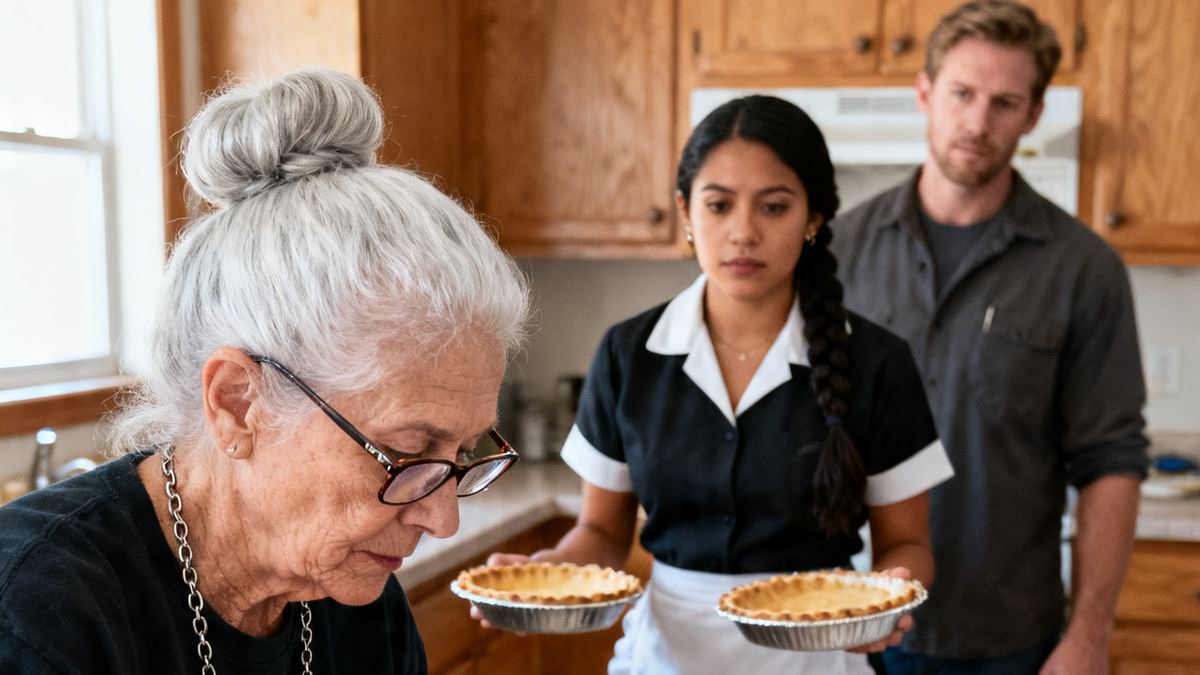
The pot roast was already a battlefield before Lily even opened her mouth. Margaret Delaney had set the table with the good china—the one with tiny blue cornflowers—and was watching her new daughter-in-law like a hawk watches a field mouse.
“Can you pass them rolls, please?” Lily said, her fork hovering over the butter dish.
“*Those* rolls,” Margaret corrected, not looking up. “And it’s ‘may I,’ not ‘can I.’ If you’re asking for something, you’re not inquiring about your physical ability.”
Daniel’s jaw tightened. “Mom, come on.”
“No, it’s okay.” Lily’s cheeks went pink, but she smiled. “Your mama’s right. I gotta learn. I mean… I *have to* learn. Mrs. Delaney’s just helpin’ me.”
Margaret took a slow sip of water. Mrs. Delaney. That’s what she insisted on, the first time Daniel brought this country girl to her house six months ago. *“Call me Mrs. Delaney, dear. We’re not on a first-name basis just yet.”*
She’d said it in that clipped, professional tone she’d perfected over thirty years as a high school English teacher. The same tone she used to shred bad essays. The same tone she now used when Lily said “I seen” or “ain’t” or “y’all.”
—
Daniel met Lily at a diner off Route 26. Not a bistro—a truck stop. Margaret found out when she saw a photo: Lily in a blue apron, holding a coffee pot in one hand and a plate of eggs over easy in the other.
“She’s a waitress,” Margaret had said flatly, the word tasting like turpentine.
“She also helps out at the preschool, Mom. She’s good with kids.”
“A preschool *aide*. And her grammar, Daniel. The girl says ‘brung’ and ‘them ones.’ How can you bring someone like that to Sunday dinner with the Hansons?”
Daniel, who fixed transmissions at a garage on Third Street, just shrugged. “I like her. She’s real.”
*Real.* As if that were a compliment. Margaret had envisioned a Bryn Mawr graduate, maybe a paralegal or a museum docent. Instead she got a girl from a farm outside Prineville whose parents died when she was little and who was raised by an aunt named Pat.
—
Aunt Pat showed up one Saturday three months after the wedding, toting mason jars of pickled beets and three pounds of homemade cheese curds. She was a large woman in a quilted vest who smelled of hay and lavender.
“So you’re the famous Mrs. Delaney!” Pat boomed, setting a jar on the granite countertop that Margaret had just wiped down. “Lily talks about you all the time. Says you’re the classiest lady she ever met.”
Margaret’s smile was tight as a zipper. She eyed the jar; the lid was sticky.
“She also says you’re a stickler for proper talk,” Pat went on, unbothered. “But I always told her, you can’t fault a person for wantin’ things right. Hey, Lily—sing that one for her. Go on.”
Lily was already pouring iced tea. She set down the pitcher, wiped her hands on her jeans, and without a shred of self-consciousness opened her mouth.
The sound that came out was not country. It was not twang or honky-tonk. It was something old—maybe a Scottish ballad, or an Appalachian lullaby—and it filled the kitchen like light through stained glass. Margaret’s hand stopped mid-reach for a napkin.
When the last note faded, Pat clapped. “See? Told you. Voice of an angel.”
Margaret cleared her throat. “That was… very pleasant.”
But she didn’t say it to Lily. She said it to the jar of pickled beets.
—
Frank, Margaret’s husband, adored Lily from the start. He’d spent years buried in silence while Margaret corrected his own casual speech. Now he had an ally.
“She taught Daniel to cook a meatloaf, Marge,” he said one night, pulling off his slippers. “Kid made a meatloaf with onions and everything. He’s never so much as boiled water in twenty-eight years.”
Margaret sniffed. “Cooking is not the same as vocabulary.”
“No, but she’s got him washing dishes and folding laundry. You think a college girl would’ve done that?”
Margaret didn’t answer. She thought of the Hanson girl down the street, who had a master’s degree and a condo in Seattle and called her parents twice a year. Thought of the Jacobs boy, who married a lawyer and divorced her over an argument about vacation homes. She stabbed her needle into her cross-stitch a little harder.
—
Lily got pregnant two years in. Margaret was in the break room at the library—she’d retired from teaching but still volunteered at the Friends of the Library book sales—when she overheard herself telling the other volunteers.
“My son’s wife is expecting,” she said, and the thrill in her voice surprised her. “I’m going to be a grandmother.”
She caught herself. *My son’s wife.* Not “the girl.” Not “that waitress.”
At the next book sorting, she found herself comparing notes with Janet Morrison, whose daughter was thirty-five and “married to her job,” and with Barbara Klein, whose son was on his third engagement. When Barbara asked why Lily never came to the book sales, Margaret said, “Well, she’s very busy with the baby. She’s a wonderful mother.”
The words felt like a foreign language, but not an unpleasant one.
—
The baby—a boy they named Owen—was born with a shock of dark hair and Lily’s wide-set blue eyes. Margaret held him in the hospital room while Lily slept, her braid trailing across the pillow.
“Look at that,” Margaret whispered to Frank. “He’s got Daniel’s chin.”
Frank leaned over. “And his grandmother’s stubbornness, I’ll bet.”
She didn’t correct him for using “grandmother” instead of “grandmama.”
Over the next decade, two more children came: Mae and little Sam. Lily, who had only a high school diploma, somehow managed to teach them to read before kindergarten. She used picture books and the songs she remembered from her own childhood. Margaret once walked into their living room—a small rental house Daniel had fixed up himself—to find Owen sounding out *Charlotte’s Web* while Lily sat on the floor with Mae in her lap, singing about a mockingbird.
Margaret stood in the doorway for a full minute without speaking. When Lily noticed her, she just smiled and said, “Hey, Mrs. Delaney. Want some coffee?”
“I… yes. And Lily? It’s Margaret. Please.”
—
Fifteen years to the day after their wedding, Daniel and Lily threw an anniversary party in their backyard. String lights crisscrossed between two maple trees, and someone had rented a karaoke machine. Lily, who still had that voice, sang Patsy Cline while Daniel fiddled with the grill.
Margaret sat in a lawn chair, a paper plate of potato salad balanced on her knee. She watched her son put his arm around Lily’s waist, still lifting her effortlessly even after all these years and three kids. Watched Owen, now thirteen, roll his eyes at his parents’ dancing. Watched Mae and Sam chase each other through the grass.
Lily caught Margaret’s eye and walked over. Her dress had a small barbecue stain on the sleeve.
“You doin’ okay? You want me to get you another drink?”
The old correction was on the tip of Margaret’s tongue—*doing*, not *doin’*—but she let it sit there, then let it go.
“No, sweetheart. I was just thinking.”
“’Bout what?” Lily asked, and this time Margaret didn’t even register the dropped “a.”
“About how lucky we are,” Margaret said. “All of us.”
Lily tilted her head, a little puzzled. Then she squeezed Margaret’s hand—a warm, flour-dusted, farm-girl grip—and went back to the karaoke machine, already humming something that sounded like a lullaby.