The House on the Rise
Clara Benson was thirty-one when the doctor in Tulsa handed her the verdict like an afterthought. He was a thin man with yellowed fingers from a two-pack-a-day habit, and he didn’t even look up from the file when he said it. “Uterine scarring is too extensive. You’re not a candidate for IVF, and natural conception is out of the question. I’m sorry.”
She didn’t cry in the office. She walked out onto South Lewis Avenue, where the August heat shimmered off the asphalt in greasy waves, and sat in her rusted Ford Taurus for forty minutes with the engine off and the windows up. A homeless man shuffled past the hood. A kid on a skateboard clattered over a storm drain. The world kept grinding forward with its infinite, indifferent noise.
Her husband, Daniel, was under a tractor when she got home to their patch of land outside Enid. She stood in the barn doorway, dust motes swirling in the late afternoon light, and told him. He slid out from underneath the machine, wiped the grease on his jeans, and didn’t say a word for almost a full minute. Then he stood up, wrapped his arms around her, and pressed his rough cheek against her hair.
“So we figure something else out,” he said. “We always do.”
That was Daniel. A man built from fence posts and stubbornness, a third-generation wheat farmer who had already weathered two foreclosures and a tornado that ripped the roof clean off the milking shed. He didn’t break, and he wouldn’t let her break either.
They tried to fill the silence for five years. They went to church potlucks. They took a bus trip to Branson to see a country music revue. Clara joined a quilting circle. Every Friday, they’d drive into town for the early bird special at the diner, and they’d sit across from each other chewing meatloaf that tasted like damp cardboard, the quiet between them growing heavier with every forkful. The farmhouse, a creaking Victorian relic that Daniel’s grandfather had staked out during the Oklahoma Land Run, felt less like a home and more like a museum of missed chances.
One Sunday, Clara drove out to the county group home. She’d seen a flyer at the library—a grainy photocopy of smiling faces under a headline that read: *Give a Child a Weekend.* Daniel had no idea she was going. She wasn’t sure herself until she’d already pulled into the cracked asphalt lot.
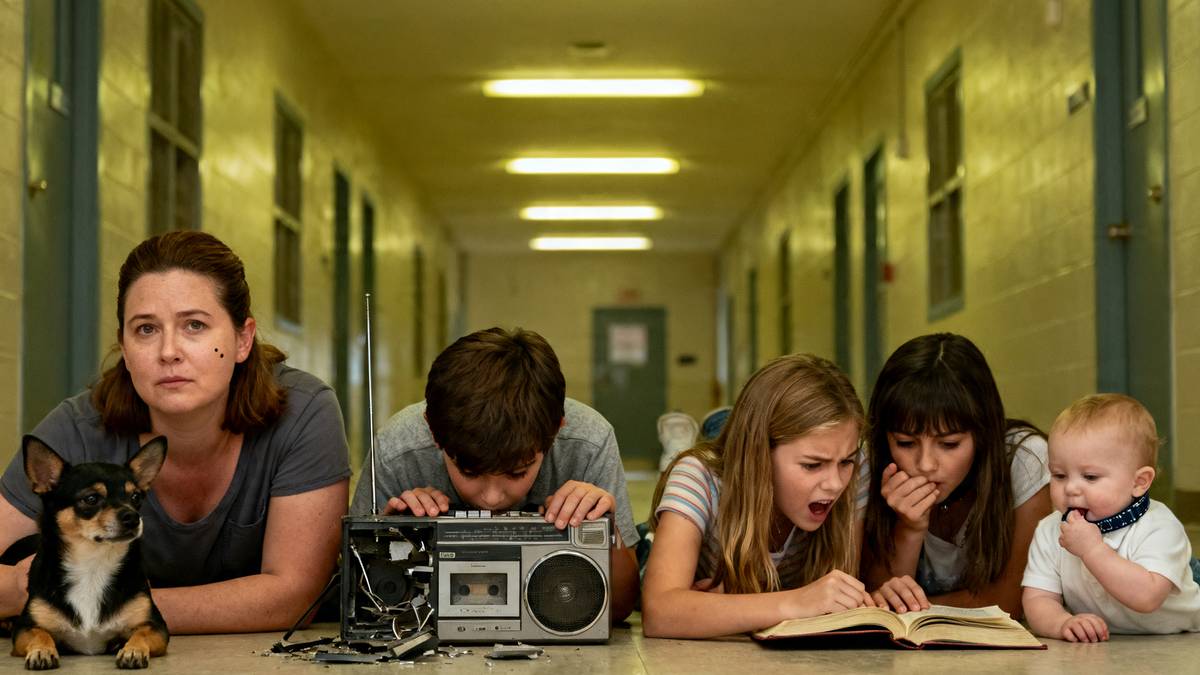
The facility was a low-slung brick building that had once been an elementary school. It smelled like bleach, boiled green beans, and something sharper underneath—fear, maybe, or neglect. A social worker named Renee with exhausted eyes led Clara down a corridor painted an optimistic shade of yellow that only made the scuff marks more visible. Through a door with a wired-glass window, she saw them.
A boy, maybe eight, was sitting cross-legged on a linoleum floor, methodically dismantling a broken radio with a butter knife. His black hair stuck up in twelve different directions. Next to him, a tiny girl with braids so tight they pulled at her temples was reading a picture book aloud, her voice a fierce whisper. She kept one arm locked protectively around a smaller boy—toddler-sized, with a runny nose and a vacant stare. He was sucking on the collar of a shirt that was two sizes too big.
The older boy looked up and caught Clara staring. His eyes were a shade of brown so dark they looked almost black, and there was nothing childlike in them. Nothing soft. He studied her face for a long moment, then went back to his radio, dismissing her entirely.
“That’s Mateo,” Renee said quietly. “He’s been in the system four years. Two failed placements. The last one sent him back because he bit the foster father. Didn’t ask questions, just bit. The man needed twelve stitches.”
“And the little ones?”
“His siblings?”
“Yeah.”
“They’re not. The two younger kids are Lily and Sam. Same mother, but no relation to Mateo. Their mom’s parental rights were terminated last month. Methamphetamine. They’re scheduled to be split up—Lily and Sam to a foster family in Lawton, Mateo to a group facility in Oklahoma City. No one takes a sibling set this large, let alone a mixed one.”
Clara watched the three of them. Lily had stopped reading. She was looking at Clara now, too, with the same guarded, unblinking assessment. Sam had crawled halfway into her lap. Mateo ignored everyone.
“What happens if no one takes all three?” Clara asked.
Renee let out a humorless laugh. “They never see each other again. That’s just how it works.”
Clara drove home in the dark, her hands shaking on the wheel. Daniel was on the porch when she pulled up. He’d been waiting for hours. She didn’t even kill the engine before she said it.
“I found our kids.”
He stared at her. “How many are we talking about?”
“Three.”
“Three,” he repeated flatly.
“Three,” she confirmed.
He sat down heavily on the porch step and looked out at the wheat field, which was nothing but a black void under the moon. An owl called somewhere in the windbreak. He rubbed the back of his neck, the way he did when a crop report went bad.
“The combine needs a new transmission,” he said. “The well pump is losing pressure. I’ve got forty acres that might need replanting if the rain doesn’t come.”
“I know.”
“Clara, we’re barely hanging on.”
“I know that too.”
He stood up, walked over to the Taurus, and leaned in through the open window. His face was weathered from sun and worry, and there was a deep groove between his eyebrows that hadn’t been there five years ago.
“You’re serious about this.”
“I’ve never been more serious about anything in my life.”
The adoption process was a war fought in triplicate forms, home inspections, background checks, and interviews with people who seemed genuinely confused about why anyone would want three damaged kids from the system. Clara navigated all of it with a quiet, ferocious patience that surprised even her. Daniel handled it the way he handled every crisis—grudgingly, skeptically, and with the grim certainty that everything would probably go wrong.
Three months later, they brought the children home.
The town of Enid had opinions. It always did. At the feed store, at the Baptist church, at the Piggly Wiggly checkout line, the whispers followed Clara like a contrail.
“Three orphans… did you hear? Not a one of ‘em related…”
“She must be desperate. No woman in her right mind…”
“Mark my words, those kids will bleed ‘em dry and then disappear. Blood tells. Always does.”
Even their neighbor, Arlene DeWitt, a widow who owned the adjoining property and had been feuding with the Bensons over a shared fence line since the Reagan administration, stopped by uninvited on moving day. She stood on the gravel drive with her arms crossed over her floral housedress and watched the children climb out of the station wagon with the slow, wary movements of strays.
“You’ve lost your mind, Clara Benson,” Arlene announced. “You can’t fix what’s broken in those ones. The state’s already ruined ‘em. They’ll rob you blind and leave you to rot.”
Clara smiled tightly. “Thank you for the welcome, Arlene. Coffee’s on inside if you’d like to stay.”
Arlene left in a huff, muttering about lawyers and property values.
The farmhouse had three bedrooms, but only two were habitable. Clara put the boys in one room—Mateo on the bottom bunk, Sam on the top, though Sam was so small he needed a stepstool to climb up—and Lily in the tiny sewing room off the kitchen. She’d painted the walls a soft blue and hung curtains with little yellow daisies.
That first night, Clara sat in the hallway with her back against the wall until three in the morning, listening. There were no sobs, no nightmares. Just a heavy, unnatural silence. Around midnight, she heard Mateo’s voice, low and steady, through the door.
“If they try to send us back, I’ll handle it,” he was saying to someone. “I got a plan.”
“What plan?” Lily’s voice, smaller.
“A plan. Don’t worry about it. Just do what I say and stay quiet. Quiet kids don’t get sent back.”
Clara pressed her hand over her mouth and cried without making a sound.
The years that followed were measured in exhaustion. Daniel worked the fields from dawn until dark, then came home to fix fences, repair the tractor, and patch the roof. Clara kept the books for a trucking company by day, waitressed at the diner on weekends, and still managed to can vegetables from the kitchen garden, sew clothes from thrift-store fabric, and help with homework at the dining table.
Mateo was the hardest. He entered fourth grade with a reputation that preceded him, and within the first week, he’d confirmed every nasty rumor. A kid on the bus called Lily a “foster rat.” Mateo gave him a bloody nose, a split lip, and a sprained wrist. The school called Clara, and the principal, a weary man named Mr. Hendricks, suggested “anger management counseling.”
Clara listened, nodded politely, and then drove the children home. In the kitchen, she sat Mateo down and looked him in the eye.
“You cannot hit people,” she said.
“He deserved it.”
“Maybe he did. You still can’t hit people. Not unless someone’s life is in danger.”
Mateo’s jaw tightened. “Then what am I supposed to do? Just let them talk?”
“You use your brain. You use your words. You walk away, or you tell a teacher, or you come home and tell me. You don’t give them ammunition to say you’re the monster they’re already calling you behind your back.”
He blinked. No one had ever told him not to be a monster before. He’d only ever been told that he was one.
“They’re gonna keep saying it,” he said quietly.
“Yes, they will. And you’re going to prove them wrong every single day until the day they choke on their own words. You understand?”
A long pause. Then Mateo nodded.
He didn’t hit anyone after that. Not because the taunting stopped—it didn’t—but because Clara was the first adult in his life who had ever demanded more of him than his worst impulses. She expected him to be better, and somehow, impossibly, that expectation took root.
Lily turned out to be the easiest of the three. She was quiet, conscientious, and fiercely protective of Sam, who still slept with a nightlight and woke up screaming from dreams he could never describe. Lily taught herself to bake pies from a 1970s Betty Crocker cookbook she found at a garage sale. She did her homework at the kitchen table without being asked. When Daniel’s back seized up during harvest, she spent three days driving the tractor while he shouted instructions from the passenger seat, a twelve-year-old girl hauling grain with a grim look of absolute concentration.
Sam was the fragile one. He caught every cold that swept through the school. He had asthma, night terrors, and a speech impediment that made him reluctant to talk. But he was also the first one to hug Clara when she walked through the door. He drew crayon pictures of the farm and labeled them “HOME” in wobbly capital letters. He followed Daniel around the barn like a shadow, handing him tools he didn’t need and asking endless questions about carburetors and soil nitrogen.
The town kept watching. Arlene DeWitt kept prophesying disaster. But the disaster never came. Instead, something slow and stubborn began to grow out on that Benson farm, something that looked a lot like a family.
By the time Mateo was a junior in high school, he was six feet tall with shoulders like a linebacker and a GPA that landed him on the honor roll. He’d discovered a talent for drafting and engineering, and his shop teacher had entered his bridge design into a state competition. It won second place.
Lily, at fifteen, was already taking anatomy and physiology classes at the community college satellite campus. She’d decided she was going to be a nurse practitioner, and anyone who told her otherwise got a look of such flat, unblinking incredulity that they usually dropped the subject.
Sam, at thirteen, had finally started to grow into his frame. His asthma was under control, his stutter was nearly gone, and he’d joined 4-H with a lamb project that ended up taking reserve champion at the county fair. He still slept with the nightlight, but he hadn’t had a nightmare in almost two years.
Arlene DeWitt’s only son, a boy named Kyle who’d been the star quarterback back in the day, had drifted away year by year. He lost a football scholarship to a DUI, then a job on a drilling crew to another one. By thirty, he’d moved to Phoenix and stopped returning his mother’s calls. Arlene spent her evenings alone in a house that was slowly falling apart around her, the roof shingles curling up in the Oklahoma wind, the porch sagging like a broken back.
The summer Mateo turned twenty-five, he came home from his job in Dallas—a structural engineering firm that paid him more money than Clara could wrap her head around—and walked the property line with a surveyor’s transit and a notebook. He didn’t say what he was doing. He just took measurements, ran calculations on his laptop, and had long, hushed phone calls on the front porch.
Lily came up from Oklahoma City, where she was working in the ICU at OU Medical Center. Sam drove in from Stillwater, where he was finishing his degree in agricultural business management. They all sat around the old oak dining table in the farmhouse, a table that had been in Daniel’s family since before statehood, and they presented their plan.
“We’re building you a new house,” Mateo said.
Daniel choked on his coffee. Clara stared at them like they’d just announced they were colonizing Mars.
“The foundation on this place is shot,” Mateo continued, in the same flat, practical tone he used for structural reports. “The wiring is a fire hazard. The plumbing is original from 1902. The roof has three separate leaks that I found in ten minutes, and I guarantee there are more I didn’t find. It’s not safe, and it’s not comfortable, and you two have been living in it for forty years. That stops now.”
Clara started to protest—money, cost, your own families, the grandchildren—but Lily cut her off.
“We’ve been saving for two years,” she said. “All three of us. The money’s already there—eighty-seven thousand dollars, give or take. Mateo called in a favor with a contractor in Tulsa who owes him from a bridge job, and Sam’s got a spreadsheet that would make an accountant weep. We can do this.”
“You have kids of your own,” Clara said, her voice cracking. “You have mortgages, car payments, medical bills—”
“You gave us everything,” Mateo said. “You gave us a life. You gave us each other.” He looked at Clara with those same dark, guarded eyes that had once measured her from a linoleum floor seventeen years ago, but the wariness was gone now. “Do you have any idea where we would be without you and Dad? Do you understand what kind of statistics we were supposed to end up in? Foster kid outcomes. I’ve read them. I know them. We were supposed to fail. All three of us. And we didn’t. Because of you.”
Daniel put his coffee mug down very carefully. His hands were weathered and gnarled from decades of fieldwork, and they shook a little.
“You’re sure about this,” he said.
“We’re sure,” said Sam. His voice was quiet, the way it still always was. “We’ve been sure for years. We were just waiting until we could afford to do it right. Lily already picked out the kitchen faucet—something called a ‘gooseneck pull-down’ in brushed nickel. I have no idea what that means, but she’s been talking about it for six months.”
Clara cried. She cried the way she hadn’t allowed herself to cry in the hospital parking lot twenty years before, the way she hadn’t cried during the adoption hearings or the hard winters or the nights when the bank account was in double digits and the pantry was down to oatmeal and hope. She cried until her ribs ached, and then she laughed, and then she cried some more.
Construction began in March. Mateo used his firm’s connections to call in favors. He got discounted lumber from a mill outside Tulsa, a framer who worked weekends for beer and old Creedence Clearwater Revival tapes, and a drywall crew that owed him from a hospital project. Lily handled the design—she’d sketched out a floor plan on graph paper, a sprawling ranch-style house with wide hallways and zero steps, because Daniel’s knees were going and she wasn’t about to let him negotiate staircases in his old age. Sam organized the logistics, managed the budget, and kept the whole mess under a hundred and twenty thousand, a number that still made Clara’s head spin but was a third of what it should have cost. He had a three-ring binder with colored tabs and a running joke about the price of copper pipe.
They built it on the rise behind the old house, where the view caught the sunset over the wheat fields and the windbreak of cottonwoods that Daniel’s father had planted during the Dust Bowl. The old house would stay—Mateo was already talking about shoring up the foundation and turning it into a guest cottage, a project for “next summer.”
The new house went up fast, faster than Clara thought possible. By late August, it was finished. A wide front porch with a ceiling fan. Big windows that let in the prairie light. A kitchen with an island and a farmhouse sink and enough counter space to roll out dough for a dozen pies. Three bedrooms for when the grandchildren came to visit. A master bathroom with a walk-in shower and grab bars that didn’t look like hospital equipment, because Lily had spent weeks researching how to make accessibility beautiful.
On the day of the move, half the town showed up. They’d heard about the house—everyone had—and they came with casseroles and folding chairs and the kind of wide-eyed rubbernecking that small towns have perfected over generations.
Arlene DeWitt came too. She’d had a stroke the previous winter, and she walked with a cane now, her body stooped and brittle. Her son Kyle hadn’t come to see her. He’d sent a check for five hundred dollars and a card that said, “Sorry to hear, get well soon.” She’d shown it to no one but kept it in her purse like a relic.
She stood at the bottom of the new porch steps, staring up at the house with its fresh paint and its green shutters and its gleaming metal roof. Clara saw her there, hesitating, looking small and lost, and walked down to meet her.
“It’s beautiful,” Arlene said. Her voice was thinner than it used to be. “It’s the nicest house in the county. Maybe the whole state.”
“Thank you, Arlene.”
The old woman looked at her for a long moment, and then something in her face crumpled. Her chin trembled. Her eyes, still sharp, welled up.
“I was wrong,” she said. “All those years ago. I was so damn sure I knew how this story was going to end, and I was wrong about all of it.”
Clara didn’t say anything. She just reached out and took Arlene’s hand. The skin was papery and thin, the knuckles swollen with arthritis.
“Kyle never calls,” Arlene whispered. “He doesn’t come. He doesn’t write. I have a son out there somewhere, and he might as well be a ghost. And you have three children who aren’t even your blood, and they built you a house.” She let out a ragged breath. “I don’t understand it. I don’t understand any of it.”
Clara squeezed her hand once, then let go and gestured toward the porch where Mateo was flipping burgers and the smell of charcoal hung in the air. “Come inside, Arlene. There’s coffee.”
The old woman hesitated, glanced at the house, then at Clara, and something in the set of her shoulders eased. She nodded, and they climbed the steps together.
That evening, after the last of the neighbors had drifted home and the crickets had started their nightly chorus, Clara sat on the new porch in a rocking chair that Daniel had carved himself. The sun was going down behind the cottonwoods, painting the wheat fields in shades of gold and rose. The air smelled like fresh-cut lumber and grilled meat and the faint, sweet tang of prairie grass.
Her children came out one by one and settled around her. Mateo leaned against the porch railing with a bottle of beer. Lily curled up in the hanging swing with her feet tucked under her. Sam sat on the steps with his youngest daughter asleep in his lap, her face pressed against his shoulder.
For a while, nobody spoke. Nobody needed to. They just watched the sun drop below the horizon, the sky shifting from amber to violet to a deep, star-scattered black.
Finally, Mateo broke the silence.
“We did okay, didn’t we?” he said.
It wasn’t really a question. Clara answered anyway.
“You did better than okay,” she said. “You did good.”
He nodded once, a sharp, decisive motion, and looked away toward the darkened fields. From inside the house, Daniel’s snore rumbled like a distant tractor, low and steady. The little girl on Sam’s shoulder stirred, then burrowed deeper. The new porch boards creaked under Clara’s rocker, and the cicadas droned on, oblivious.