Gus lived behind the old paper mill. He built a crooked shelter out of shipping pallets, a blue tarp, and a piece of corrugated tin that rattled every time a freight train rolled through. In Pennsylvania winters the wind came straight off the river and tore right through that shack, and in August the whole thing baked like an oven. But my mother, Nora, never cared about the weather. For twenty years, she walked half a mile from our trailer every single day to bring him food.
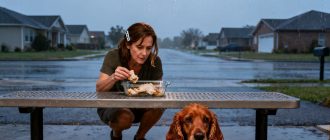
Monday was chicken and rice. Wednesday was beef stew. Friday was whatever vegetables were about to turn, thrown into a pot with noodles and enough garlic to knock a man over. She never missed a day. Not when the gas company shut our heat off in February. Not when I was wearing sneakers held together with duct tape for the entire eighth grade. Not when she picked up double shifts at the diner and still came home, exhausted, and packed a Tupperware container for a man who lived in a pile of pallets.
I hated it. I remember sitting at the kitchen table at fifteen, staring at an eviction notice taped to the refrigerator door, and she was spooning lentil soup into a bowl for Gus. I snapped.
“You know, if you stopped feeding some random guy behind the mill, maybe we’d have money for rent.”
She stopped mid-scoop. Her knuckles went white around the ladle. She didn’t yell, but something in her face shut down. When she finally spoke, her voice was quieter than I’d ever heard it.
“Don’t you ever talk like that again, Caleb. Not about him.”
I dropped it, but I didn’t forgive her. I thought she was choosing a stranger over me.
I left Millvale the week after graduation. Got a job at a distribution center outside Harrisburg, then another one driving a forklift in Allentown. I called home less and less. When I did visit, there was Mom heading out the door with a foil-wrapped plate, the same way she’d always done. I’d watch her through the window, trudging across the gravel lot toward the mill, and I’d feel that old resentment twist in my chest. She never explained. I never asked.
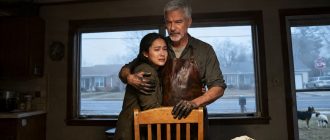
Then she got sick. Pancreatic cancer, stage four. By the time they found it, there wasn’t much to do except keep her comfortable. I moved back home. Every week she shrank a little more. The woman who never stopped moving was suddenly too tired to sit up for more than an hour.
Two weeks before she passed, she grabbed my wrist with a grip that felt like a vise. Her hand was cold, the skin almost translucent.
“Caleb. You have to promise me something.”
“Anything, Mom.”
“You’ll keep bringing Gus his food. Every day. Don’t let him go hungry.”
I opened my mouth to argue, but the look in her eyes stopped me. It wasn’t just a request. It was the only thing she was holding on to.
“I promise.”
She let out a long breath and closed her eyes. Those were the last coherent words she said to me.
The funeral was small. A handful of neighbors, a couple of waitresses from the diner, the pastor from the Methodist church. Gus didn’t come. I figured maybe he didn’t know. Or maybe he didn’t care.
The morning after, I did what I’d promised. I made a pot of vegetable barley soup — her recipe, thirty minutes of chopping and simmering while the empty trailer echoed around me. I wrapped a chunk of sourdough bread in a kitchen towel, grabbed the Tupperware, and headed across the lot.
The shack was gone. Not just empty — dismantled. The pallets had been taken apart and stacked neatly by the fence. The tarp was folded. The corrugated metal was leaning against a maple tree. It looked like no one had ever lived there.
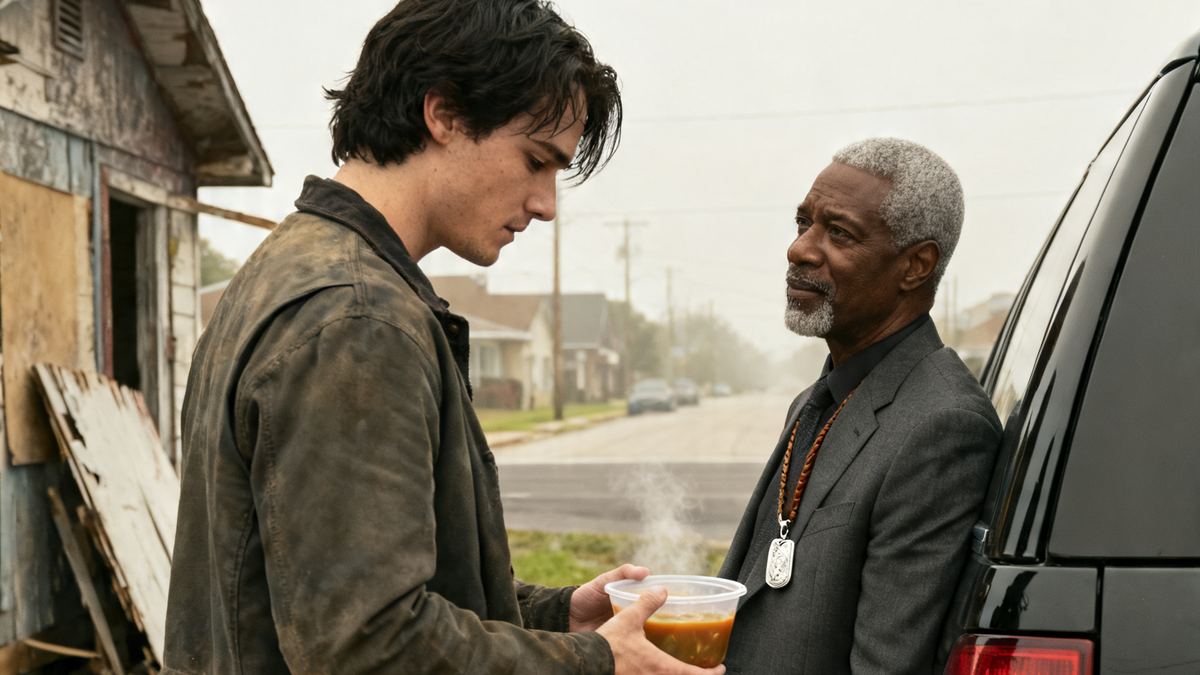
I stood there with a container of soup steaming in my hands and felt completely lost. Then I noticed a black Lincoln Navigator idling at the edge of the gravel lot. A man in a charcoal suit was leaning against the driver’s door. He had close-cropped gray hair, a clean-shaven face, and a watch that glinted even in the overcast morning light. Around his neck, on a thin leather cord, hung my mother’s silver locket. The one she swore she’d lost when I was ten.
The man looked at me and gave a tired, sad smile.
“I figured you’d be here in the morning.”
I stopped about ten feet away. “I’m sorry, who…”
“Gus.”
The Tupperware nearly slipped out of my hand. I stared at him. I’d only ever seen Gus in layers of stained flannel, beard tangled, eyes downcast. This man stood straight. He smelled like sandalwood.
“That’s not possible,” I said.
He touched the locket. “Twenty-two years changes a man. Sometimes more than once.”
I stood there, foolish, holding out the soup. “I… brought your dinner. Mom would’ve wanted me to.”
He took the container gently. His hands were steady, the nails clean. He looked at the fogged-up plastic lid and something broke in his face. Tears welled up, but he held them in place.
“She knew you’d keep your word.”
We stood in silence. A freight train sounded in the distance.
“Caleb, your mother kept something from you,” he said finally. “And she made me swear I’d never tell.”
My throat tightened. “Tell what?”
He reached into his jacket and pulled out an envelope. Yellowed paper, my name written in my mother’s handwriting. The sight of it hit me harder than the funeral had.
“She said you could open this only after she was gone.”
I tore the envelope with shaking fingers. Inside was a single sheet of notebook paper, covered in her neat, slanted cursive.
*Caleb, if you’re reading this, I’m already gone. There’s a truth I hid from you your whole life, and it’s time you knew. Not because I didn’t trust you, but because I made a promise to the man who gave us both a second chance.*
I looked up. Gus was watching me, his jaw tight.
“What does she mean, a second chance?”
He took a long breath. “Back when you were four years old, your trailer caught fire. Middle of the night. Electrical short in the kitchen.”
I remembered nothing. Just fragments of heat and sirens.
“I wasn’t homeless then,” he said. “I owned a contracting company. Had a wife, a house over in Monroeville. I was driving home from a late job and saw the flames from the highway. By the time I pulled over, the whole front end was burning. Neighbors were standing around, nobody would go in. But I heard a kid crying inside. That was you.”
His voice caught. He steadied himself against the Navigator.
“I went in. Found you under a blanket in the back bedroom. Carried you out maybe twenty seconds before the roof caved in. I got third-degree burns on my back and arms. Six surgeries. Couldn’t work for almost two years. The business went under. My wife couldn’t handle the bills, the pain, the drinking I fell into. She left. By the time I was on my feet again, I had nothing. A few years later, I wound up sleeping behind the paper mill.”
The soup container in his hands was shaking now.
“Your mom recognized me about a year into it. She came looking for the man who pulled you out of that fire. Found me living under a tarp. She cried for an hour. Tried to give me money, tried to find me a place to stay. I wouldn’t take a cent. I was too proud, I guess. Too broken. So she said, ‘If you won’t let me repay you, then you’ll let me feed you. Every day. For as long as we both live.’”
I was crying openly now, not even trying to stop it.
“That’s why she did it,” I said. “Not charity. She was thanking you.”
“She was keeping me alive,” Gus said. “Not just with food. She’d sit with me on that broken crate, listen to me talk about nothing for an hour. She made me feel like I still mattered to someone. I tried to tell her she didn’t owe me anything. She said she’d already made up her mind.”
I thought about every sarcastic comment I’d ever made. Every time I’d rolled my eyes when she reached for that ladle. The shame was a physical weight in my chest.
“Why didn’t she tell me?”
“Because she didn’t want you carrying guilt,” he said. “She said you’d figure out how to help people on your own, when you were ready. Not out of obligation.”
Gus handed me a second item — a manila folder. Inside were bank statements, investment documents, contracts from the last ten years. He had slowly rebuilt his business, consulting for commercial projects, investing wisely, clawing his way back to real money. The folder showed an account balance that made my head spin.
“I’ve been financially stable for a while now,” he said quietly. “But I never left that shack. Not because I couldn’t. Because I promised your mom I wouldn’t let money change what we had. She brought me soup, but what she really brought was the feeling that I was still a human being worth sitting with. That’s not something you can buy.”
I set the folder on the hood of the Lincoln. There was a full ten seconds when neither of us spoke. And then I did something I hadn’t done since I was a child. I hugged him. I felt his back under the expensive suit jacket, the uneven ridges of scar tissue through the fabric. He held on tight, and we both broke down right there in that gravel lot.
Six months later, we opened a soup kitchen in downtown Millvale. We called it Nora’s Table. Every weekday, from eleven to two, anyone can walk in and get a hot meal — no questions, no paperwork, no sermon. The walls are painted the same butter-yellow as my mother’s kitchen, and there’s a framed quote hanging near the serving window: “One bowl of soup can’t fix the world. But it can remind a person the world hasn’t given up on them.”
Gus runs the business side. I handle the kitchen. Most days, when the lunch rush slows down and I’m wiping down the counters, I think about those twenty years of stews and casseroles and foil-wrapped bread. And I understand, finally, that my mother wasn’t feeding a stranger. She was keeping a promise to the man who once ran into a burning trailer and carried her son out in his arms.